About the Church
The Church of St Stanislaus Kostka at Dūkštas is an impressive Late Baroque building, rich in historical vicissitudes and mystery. The church, standing in the town of Dūkštas, is named after St Stanislaus Kostka (1550–1568), a young Jesuit who became the patron of many young people.
The first wooden church on the Dūkštas manor, in what is now the village of Dūkšteliai, was built around 1601. The manor's owners, the Rudamina family, had a hand in its building. These were times when religious architecture not only adorned the landscape but also shaped local communities. After being rebuilt in 1674, the church became a further centre of religious activity, and from 1729 to 1773 a Jesuit mission operated here.
A little over two centuries later, in 1901, the office of sacristan was taken up by Bernardas Raštikis, father of General Stasys Raštikis. He not only looked after the church but also distributed the Lithuanian press, thereby contributing to the national revival. In the first decade of the 20th century a branch of the Lithuanian Catholic Temperance Society was active, promoting the values of temperance and morality.
A parish established in 1925 became a new centre of religious activity, and the parish priest Konstantinas Šimašis, through his work and persistence, strengthened the community even during the Polish occupation. Through his efforts a branch of the Society of St Casimir, schools and libraries were set up. Zenonas Butkevičius, parish priest from 1927 to 1937, repaired the church – reinforcing the walls, replacing the beams, re-covering the roof and installing electricity. During this time the painter Petras Sergejevičius produced a good many paintings, which adorned the interior of the church.
Unfortunately, the old church burned down in 1956. However, the present wooden church had already been built in 1934–1936. Although it was still unfinished, it was consecrated by Archbishop Romuald Jałbrzykowski on 29 May 1935. After the fire, this church became the main church of the united Dūkštas parish.
The architectural design is also worth noting. The church has a rectangular plan, a single tower, an apse and a small turret. Inside there are three naves, the side ones considerably lower than the central one. A low wooden bell tower stands in the churchyard, forming with the church a harmonious and aesthetically pleasing ensemble.
So the Church of St Stanislaus Kostka at Dūkštas has not only lifted and continues to lift the spirits of the local people, but is also an important historical and cultural monument, telling of the past and traditions of this region.
The first wooden church on the Dūkštas manor, in what is now the village of Dūkšteliai, was built around 1601. The manor's owners, the Rudamina family, had a hand in its building. These were times when religious architecture not only adorned the landscape but also shaped local communities. After being rebuilt in 1674, the church became a further centre of religious activity, and from 1729 to 1773 a Jesuit mission operated here.
A little over two centuries later, in 1901, the office of sacristan was taken up by Bernardas Raštikis, father of General Stasys Raštikis. He not only looked after the church but also distributed the Lithuanian press, thereby contributing to the national revival. In the first decade of the 20th century a branch of the Lithuanian Catholic Temperance Society was active, promoting the values of temperance and morality.
A parish established in 1925 became a new centre of religious activity, and the parish priest Konstantinas Šimašis, through his work and persistence, strengthened the community even during the Polish occupation. Through his efforts a branch of the Society of St Casimir, schools and libraries were set up. Zenonas Butkevičius, parish priest from 1927 to 1937, repaired the church – reinforcing the walls, replacing the beams, re-covering the roof and installing electricity. During this time the painter Petras Sergejevičius produced a good many paintings, which adorned the interior of the church.
Unfortunately, the old church burned down in 1956. However, the present wooden church had already been built in 1934–1936. Although it was still unfinished, it was consecrated by Archbishop Romuald Jałbrzykowski on 29 May 1935. After the fire, this church became the main church of the united Dūkštas parish.
The architectural design is also worth noting. The church has a rectangular plan, a single tower, an apse and a small turret. Inside there are three naves, the side ones considerably lower than the central one. A low wooden bell tower stands in the churchyard, forming with the church a harmonious and aesthetically pleasing ensemble.
So the Church of St Stanislaus Kostka at Dūkštas has not only lifted and continues to lift the spirits of the local people, but is also an important historical and cultural monument, telling of the past and traditions of this region.
Gallery and Resources
Archive captions are shown in Lithuanian.
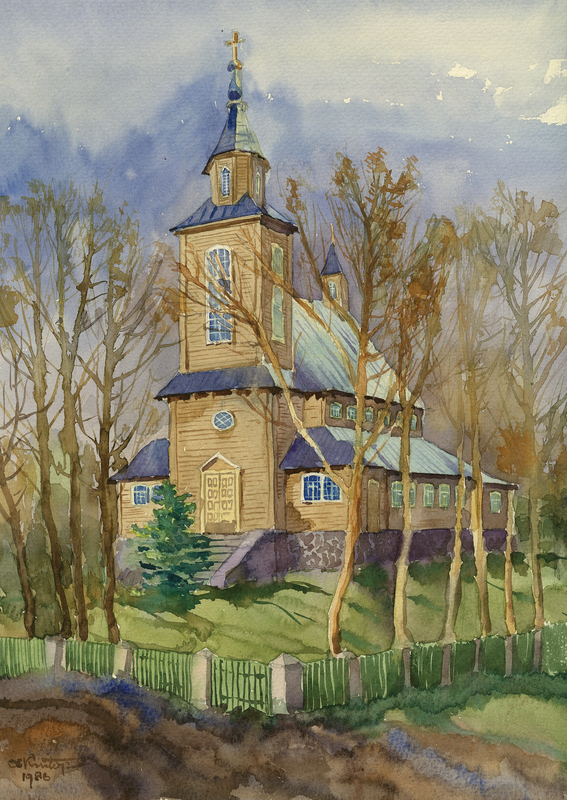
Kompozicijoje – Dūkšto Šv. Stanislovo Kostkos bažnyčia.
Signuotas akvarele averso apatinėje dalyje kairėje.