About the Church
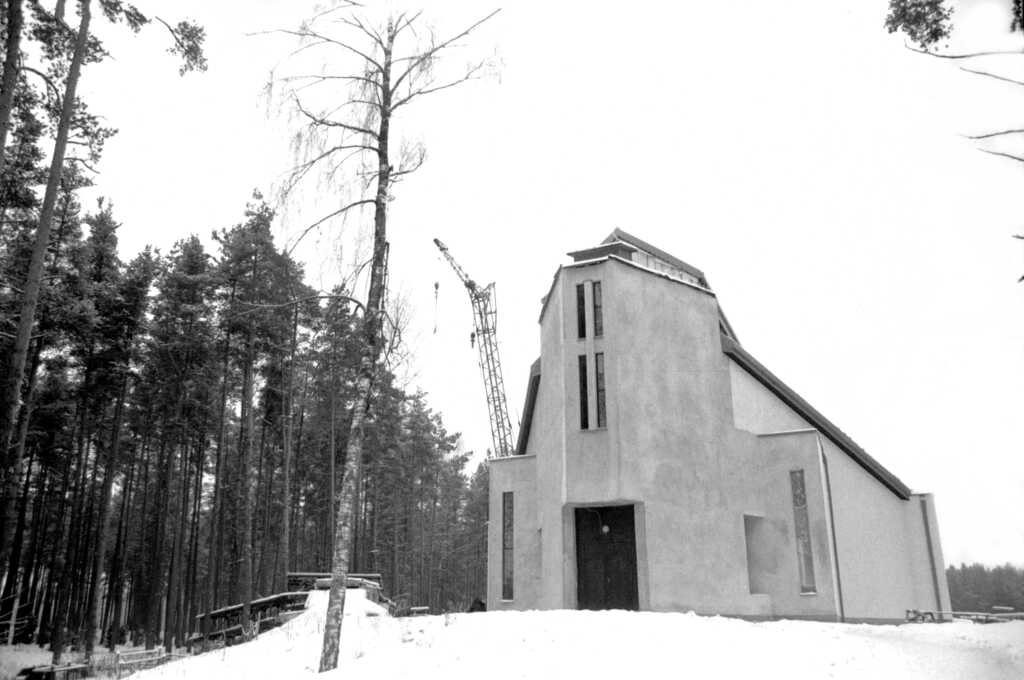
The Church of St Paul the Apostle in Visaginas is not only a piece of architecture but also a symbolic centre of the Visaginas community, raised through various challenges and changes. The church's history begins back in 1989, when on 16 October a permit was issued for the establishment of a Catholic religious community in the Sniečkus settlement and for the building of a new church. At the time the authorities of Sniečkus (now Visaginas) allocated premises – the hall of the Vocational Technical School hostel, where the first Holy Mass was celebrated in December.
In 1992 the Catholic parish of Visaginas took the name of St Paul the Apostle. That same year a search began for a more suitable site for a permanent church. After lengthy deliberation and obstacles, the final building site was chosen on a small hill by the junction of Santarvės and Statybininkų streets. Interestingly, this site had been earmarked as a recreational area for a town park, but a storm that devastated the pine wood cleared the ground for the church's construction.
Building work officially began on 2 November 1992, when wind-felled pines were cut and earthworks began. The general contractor was the Ignalina Nuclear Power Plant, and the works were carried out by Construction and Assembly Board No. 2. Within a few years the church was completed, and in 1998 it opened its doors to the faithful.
A striking detail about this church is the ancient bell that rang out in its tower on 10 April 2004, brought from the bell tower of Vilnius Archcathedral Basilica. This bell, weighing about 1,200 kg, was fixed to a new swinging beam, and a new clapper was designed and made for it.
Another significant moment in the church's history came on 30 December 2010, when the new organ sounded for the first time. It was an instrument built by the firm of Laimis Pikutis, with 2 manuals and pedal and 29 stops, donated to the church by generous benefactors and supporters.
Today the Church of St Paul the Apostle in Visaginas is not only a place of prayer but also a centre for community gatherings, bringing together the faithful who pray in Lithuanian and in Polish. Its interior and exterior speak of a long and rich history, full of challenges and achievements.
In 1992 the Catholic parish of Visaginas took the name of St Paul the Apostle. That same year a search began for a more suitable site for a permanent church. After lengthy deliberation and obstacles, the final building site was chosen on a small hill by the junction of Santarvės and Statybininkų streets. Interestingly, this site had been earmarked as a recreational area for a town park, but a storm that devastated the pine wood cleared the ground for the church's construction.
Building work officially began on 2 November 1992, when wind-felled pines were cut and earthworks began. The general contractor was the Ignalina Nuclear Power Plant, and the works were carried out by Construction and Assembly Board No. 2. Within a few years the church was completed, and in 1998 it opened its doors to the faithful.
A striking detail about this church is the ancient bell that rang out in its tower on 10 April 2004, brought from the bell tower of Vilnius Archcathedral Basilica. This bell, weighing about 1,200 kg, was fixed to a new swinging beam, and a new clapper was designed and made for it.
Another significant moment in the church's history came on 30 December 2010, when the new organ sounded for the first time. It was an instrument built by the firm of Laimis Pikutis, with 2 manuals and pedal and 29 stops, donated to the church by generous benefactors and supporters.
Today the Church of St Paul the Apostle in Visaginas is not only a place of prayer but also a centre for community gatherings, bringing together the faithful who pray in Lithuanian and in Polish. Its interior and exterior speak of a long and rich history, full of challenges and achievements.
Gallery and Resources
Archive captions are shown in Lithuanian.
Visagino katalikų bažnyčia.