About the Church
The Church of Our Lady of the Rosary at Smalvos, standing in the village of Smalvos, is one of the most striking examples of wooden vernacular architecture in Lithuania. Set in the middle of the village, next to a road junction, it undoubtedly catches the eye of locals and visitors alike with its unique style and history.
The church's origins go back to 1598, when Jonas Samsonas, a clerk of the Braslaw land court, assigned the Jurgiškiai plot and several villages for the church's needs. Soon afterwards, around 1600, a monastery of the Canons Regular of Penance was founded, which also took care of the church. Over the years the church itself underwent a good many changes: it was rebuilt, reconstructed, and its interior decorated.
In 1674 Kazimieras Podbereskis, a judge of the Braslaw land court, built a new wooden church on the site of the earlier chapel. At that time the church became an important religious centre, and the parish was established in 1750. In later years the church was rebuilt and, thanks to Count Plater and the parishioners, became still more imposing.
Its history is marked by dramatic moments, such as in 1812, when the French army damaged the monastery, and in 1832, when it was closed. Despite this, in 1855 Count Plater built the chapel of St Rosalia in the Smalvos cemetery, and the present wooden church was built in 1857.
The years 1866–1869 were especially hard for the parish priest Teofilis Rudys, who for various reasons was punished and eventually exiled. Yet even these troubles did not stop the community caring for its church. In 1897 the parish cemetery was enclosed with a masonry wall, and at the start of the 20th century Zaborskis decorated the church's interior with colourful plant ornament.
A disaster in 1902, when lightning struck the church tower, did not break the community's spirit. The church was restored and reopened to worshippers. In the middle of the 20th century, in 1982, a two-storey open porch with a pitched roof was built, adding to the building's beauty.
Architecturally the church stands out for its rectangular plan and single tower. It is 25.2 m long, 17.6 m wide, and about 15 m high. The church is listed in the Register of Cultural Property under the unique code 1789. The churchyard fence is made of stone masonry, and a three-tier wooden bell tower stands in the churchyard.
An important work of art in the church is a bronze bell, cast in 1780 at the initiative of the parish priest P. Zviaginas, decorated with two ornamented bands and a relief of St George. This bell is a symbol of the church's long history and cultural value.
The Church of Our Lady of the Rosary at Smalvos is undoubtedly not only a masterpiece of architecture but also a living witness to history, linking past and present, and through its historical vicissitudes and architectural worth it remains an important part of Lithuania's religious and cultural life.
The church's origins go back to 1598, when Jonas Samsonas, a clerk of the Braslaw land court, assigned the Jurgiškiai plot and several villages for the church's needs. Soon afterwards, around 1600, a monastery of the Canons Regular of Penance was founded, which also took care of the church. Over the years the church itself underwent a good many changes: it was rebuilt, reconstructed, and its interior decorated.
In 1674 Kazimieras Podbereskis, a judge of the Braslaw land court, built a new wooden church on the site of the earlier chapel. At that time the church became an important religious centre, and the parish was established in 1750. In later years the church was rebuilt and, thanks to Count Plater and the parishioners, became still more imposing.
Its history is marked by dramatic moments, such as in 1812, when the French army damaged the monastery, and in 1832, when it was closed. Despite this, in 1855 Count Plater built the chapel of St Rosalia in the Smalvos cemetery, and the present wooden church was built in 1857.
The years 1866–1869 were especially hard for the parish priest Teofilis Rudys, who for various reasons was punished and eventually exiled. Yet even these troubles did not stop the community caring for its church. In 1897 the parish cemetery was enclosed with a masonry wall, and at the start of the 20th century Zaborskis decorated the church's interior with colourful plant ornament.
A disaster in 1902, when lightning struck the church tower, did not break the community's spirit. The church was restored and reopened to worshippers. In the middle of the 20th century, in 1982, a two-storey open porch with a pitched roof was built, adding to the building's beauty.
Architecturally the church stands out for its rectangular plan and single tower. It is 25.2 m long, 17.6 m wide, and about 15 m high. The church is listed in the Register of Cultural Property under the unique code 1789. The churchyard fence is made of stone masonry, and a three-tier wooden bell tower stands in the churchyard.
An important work of art in the church is a bronze bell, cast in 1780 at the initiative of the parish priest P. Zviaginas, decorated with two ornamented bands and a relief of St George. This bell is a symbol of the church's long history and cultural value.
The Church of Our Lady of the Rosary at Smalvos is undoubtedly not only a masterpiece of architecture but also a living witness to history, linking past and present, and through its historical vicissitudes and architectural worth it remains an important part of Lithuania's religious and cultural life.
Gallery and Resources
Archive captions are shown in Lithuanian.
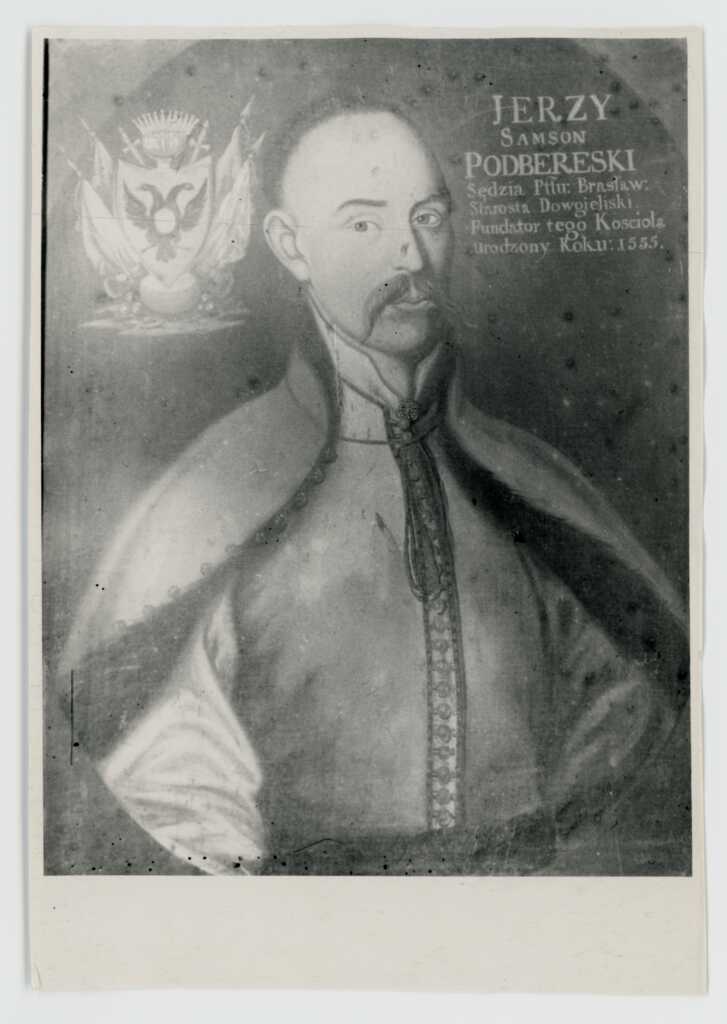
Jurgio Samsono Podbereckio (Smalvų bažnyčios fundatoriaus) portretas. Paveikslas. Smalvų bažnyčia.