About the Church
The Church of St Anthony of Padua in Eitminiškės is a wooden house of prayer standing in the small village of Eitminiškės, in Vilnius district. This church, built in 1924, stands on the right bank of the Nemenčia river, about 9 kilometres from the town of Nemenčinė.
The church has deep historical roots. Eitminiškės was already assigned to the Vilnius Missionaries in 1685, who most likely built the first chapel. Unfortunately, this chapel was closed by the Russian authorities in 1866. Only many years later, in 1922, was a parish founded, and two years afterwards the present wooden church was built.
The history of this house of prayer is closely bound up with Father Ambraziejus Jakavonis, who was appointed parish priest in Eitminiškės in 1934. He was not only a clergyman but also an important figure in Lithuanian society. His life ended tragically – in April 1944, during Easter, a unit of the Armia Krajowa broke into his presbytery, took him away and killed him at an unknown location. In memory of the priest, a memorial stone was erected in the church's churchyard in 1988, the work of the architect Napalys Kitkauskas.
Architecturally, the church in Eitminiškės is simple yet at the same time highly expressive. It is on a rectangular plan, without a tower, its roof front covered by a raised wall with a triangular pediment. The apse has five sides, and the sacristies are low and set close against the main building. The entire grounds are enclosed by a stone masonry fence, giving the place a distinctive character.
Services in this church are held in Polish, reflecting the ethnic make-up of the area and its historical context. Beside the church also stands the small chapel of Eitminiškės, further strengthening the sacred aura of this shrine.
A visit to the Church of St Anthony of Padua in Eitminiškės is an excellent opportunity to come into contact with Lithuania's religious history and to admire authentic wooden architecture that radiates peace and spirituality.
The church has deep historical roots. Eitminiškės was already assigned to the Vilnius Missionaries in 1685, who most likely built the first chapel. Unfortunately, this chapel was closed by the Russian authorities in 1866. Only many years later, in 1922, was a parish founded, and two years afterwards the present wooden church was built.
The history of this house of prayer is closely bound up with Father Ambraziejus Jakavonis, who was appointed parish priest in Eitminiškės in 1934. He was not only a clergyman but also an important figure in Lithuanian society. His life ended tragically – in April 1944, during Easter, a unit of the Armia Krajowa broke into his presbytery, took him away and killed him at an unknown location. In memory of the priest, a memorial stone was erected in the church's churchyard in 1988, the work of the architect Napalys Kitkauskas.
Architecturally, the church in Eitminiškės is simple yet at the same time highly expressive. It is on a rectangular plan, without a tower, its roof front covered by a raised wall with a triangular pediment. The apse has five sides, and the sacristies are low and set close against the main building. The entire grounds are enclosed by a stone masonry fence, giving the place a distinctive character.
Services in this church are held in Polish, reflecting the ethnic make-up of the area and its historical context. Beside the church also stands the small chapel of Eitminiškės, further strengthening the sacred aura of this shrine.
A visit to the Church of St Anthony of Padua in Eitminiškės is an excellent opportunity to come into contact with Lithuania's religious history and to admire authentic wooden architecture that radiates peace and spirituality.
Gallery and Resources
Archive captions are shown in Lithuanian.
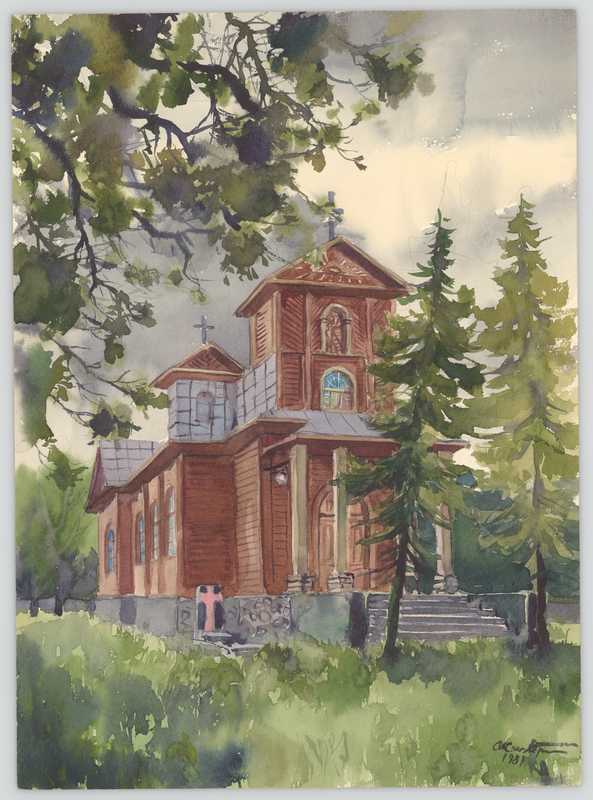
Eitminiškių Šv. Antano Paduviečio bažnyčia.
Signuotas akvarele averso apatinėje dalyje dešinėje, pieštuku reverso viršutinėje dalyje kairėje.