About the Church
The Church of the Sacred Heart of Jesus in Paberžė is an impressive sacred structure, standing in the village of Paberžė, beside the old Vilnius–Molėtai road. It is not only an architectural masterpiece but also a witness to historical events.
The first wooden church on this site is thought to have been built around 1484, carefully looked after by Jurgis Paulavičius, the parish priest of Maišiagala. The parish was officially established in 1503, and shortly afterwards, in 1507, Sigismund the Old permitted an inn to be set up in the village, its income earmarked for the church's upkeep. At that time monks also lived in Paberžė – Canons Regular of Penance, who likewise contributed to the running of the parish school.
Over the centuries the church changed and was rebuilt several times. A new church was built by 1676, and in 1759 it was rebuilt again, in wood. Later, in 1793, this church was rebuilt once more, so as to adapt it to the growing community.
In the middle of the 19th century construction began on a new wooden church, which, approved in 1859, was completed in 1860. However, these buildings did not remain long in Catholic hands. On 1 April 1866 Father Jonas Stšeleckis held the last Catholic services, after which he announced that he was converting to Orthodoxy and urged the parishioners to follow his example. The church was handed over to the Orthodox Church, and the former Catholic clergyman A. Petkevičius even delivered a sermon in Lithuanian, although Stšeleckis himself did not know Lithuanian.
At the start of the 20th century the Orthodox built a masonry church of their own, and in 1904 the Minister of Internal Affairs permitted a Catholic filial church to be built in Paberžė. After several decades of struggle over the church's construction between the Polish-speaking and Lithuanian-speaking communities, the present Gothic Revival masonry church with two towers finally rose in 1932.
Today the Church of the Sacred Heart of Jesus in Paberžė is a gem of Gothic Revival architecture, on a Latin-cross plan, with towers notable for their ornateness. The church is enclosed by a fence of stone masonry and wooden structures, giving it a particular old-world charm.
A visit to this church allows one not only to admire the architectural details or pray quietly, but also to learn about the rich and complex history of the Paberžė region. Services here are held in both Lithuanian and Polish, reflecting the multicultural character of the community.
The first wooden church on this site is thought to have been built around 1484, carefully looked after by Jurgis Paulavičius, the parish priest of Maišiagala. The parish was officially established in 1503, and shortly afterwards, in 1507, Sigismund the Old permitted an inn to be set up in the village, its income earmarked for the church's upkeep. At that time monks also lived in Paberžė – Canons Regular of Penance, who likewise contributed to the running of the parish school.
Over the centuries the church changed and was rebuilt several times. A new church was built by 1676, and in 1759 it was rebuilt again, in wood. Later, in 1793, this church was rebuilt once more, so as to adapt it to the growing community.
In the middle of the 19th century construction began on a new wooden church, which, approved in 1859, was completed in 1860. However, these buildings did not remain long in Catholic hands. On 1 April 1866 Father Jonas Stšeleckis held the last Catholic services, after which he announced that he was converting to Orthodoxy and urged the parishioners to follow his example. The church was handed over to the Orthodox Church, and the former Catholic clergyman A. Petkevičius even delivered a sermon in Lithuanian, although Stšeleckis himself did not know Lithuanian.
At the start of the 20th century the Orthodox built a masonry church of their own, and in 1904 the Minister of Internal Affairs permitted a Catholic filial church to be built in Paberžė. After several decades of struggle over the church's construction between the Polish-speaking and Lithuanian-speaking communities, the present Gothic Revival masonry church with two towers finally rose in 1932.
Today the Church of the Sacred Heart of Jesus in Paberžė is a gem of Gothic Revival architecture, on a Latin-cross plan, with towers notable for their ornateness. The church is enclosed by a fence of stone masonry and wooden structures, giving it a particular old-world charm.
A visit to this church allows one not only to admire the architectural details or pray quietly, but also to learn about the rich and complex history of the Paberžė region. Services here are held in both Lithuanian and Polish, reflecting the multicultural character of the community.
Gallery and Resources
Archive captions are shown in Lithuanian.
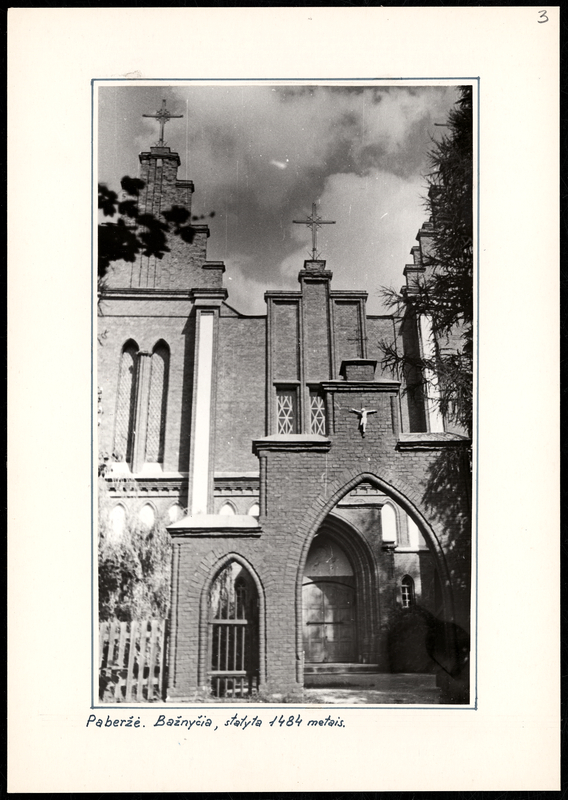
Paberžės Švč. Jėzaus Širdies bažnyčia. Fotografijos aprašymas ant pasporto: „Paberžė. Bažnyčia, statyta 1484 metais.“

Paberžės Švč. Jėzaus Širdies bažnyčia.
Signuotas akvarele averso apatinėje dalyje kairėje, pieštuku reverso viršutinėje dalyje.