About the Church
The church of the Assumption of the Blessed Virgin Mary in Kabeliai is one of those places where history, faith and culture come together. This wooden church, built in 1911, is a gem of folk architecture, standing in the village of Kabeliai, near Marcinkonys.
The church's history began when the Governor-General of Vilnius permitted, in 1909, the old church of Ratnyčia (St Bartholomew the Apostle) to be moved to Kabeliai. Having arrived and taken root there, the church was enlarged in 1916, and a parish was established here just five years later. From 1919 the parish priest Pranciškus Čaglys actively fostered his parishioners' devotion, nurtured Lithuanian identity and promoted education, although he suffered persecution by the Polish authorities for it.
In the Soviet period, when many forms of religious activity were banned or restricted, the Kabeliai parish became the centre of an underground seminary for priests. Priests were secretly trained and ordained at the presbytery, and information was gathered for the Chronicle of the Catholic Church in Lithuania. Figures such as the Jesuit priest Karolis Garuckas and his pupil Jonas Lauriūnas served in this church, strengthening faith and resistance to the Soviet regime.
One of the most notable features of the Kabeliai church is its folk-architecture form – rectangular in plan, with a two-tower structure and low sacristies. A two-tier wooden bell tower stands in the churchyard, which likewise testifies to the region's architectural heritage. Interestingly, in 2020 parts of an old organ were found in the church's loft, which are believed to have been played by Konstantinas Čiurlionis, father of the famous composer Mikalojus Konstantinas Čiurlionis.
Every year on 15 August the parish's patronal feast is held here – Žolinė (the Assumption), which draws a large gathering of worshippers. Besides Kabeliai, the present parish priest, Bronius Krakevičius, also serves the parish of Sts Simon and Jude Thaddeus the Apostles in Marcinkonys. Today the Kabeliai church not only preserves historical memory but also continues to serve as an important spiritual centre for the local community.
The church's history began when the Governor-General of Vilnius permitted, in 1909, the old church of Ratnyčia (St Bartholomew the Apostle) to be moved to Kabeliai. Having arrived and taken root there, the church was enlarged in 1916, and a parish was established here just five years later. From 1919 the parish priest Pranciškus Čaglys actively fostered his parishioners' devotion, nurtured Lithuanian identity and promoted education, although he suffered persecution by the Polish authorities for it.
In the Soviet period, when many forms of religious activity were banned or restricted, the Kabeliai parish became the centre of an underground seminary for priests. Priests were secretly trained and ordained at the presbytery, and information was gathered for the Chronicle of the Catholic Church in Lithuania. Figures such as the Jesuit priest Karolis Garuckas and his pupil Jonas Lauriūnas served in this church, strengthening faith and resistance to the Soviet regime.
One of the most notable features of the Kabeliai church is its folk-architecture form – rectangular in plan, with a two-tower structure and low sacristies. A two-tier wooden bell tower stands in the churchyard, which likewise testifies to the region's architectural heritage. Interestingly, in 2020 parts of an old organ were found in the church's loft, which are believed to have been played by Konstantinas Čiurlionis, father of the famous composer Mikalojus Konstantinas Čiurlionis.
Every year on 15 August the parish's patronal feast is held here – Žolinė (the Assumption), which draws a large gathering of worshippers. Besides Kabeliai, the present parish priest, Bronius Krakevičius, also serves the parish of Sts Simon and Jude Thaddeus the Apostles in Marcinkonys. Today the Kabeliai church not only preserves historical memory but also continues to serve as an important spiritual centre for the local community.
Gallery and Resources
Archive captions are shown in Lithuanian.
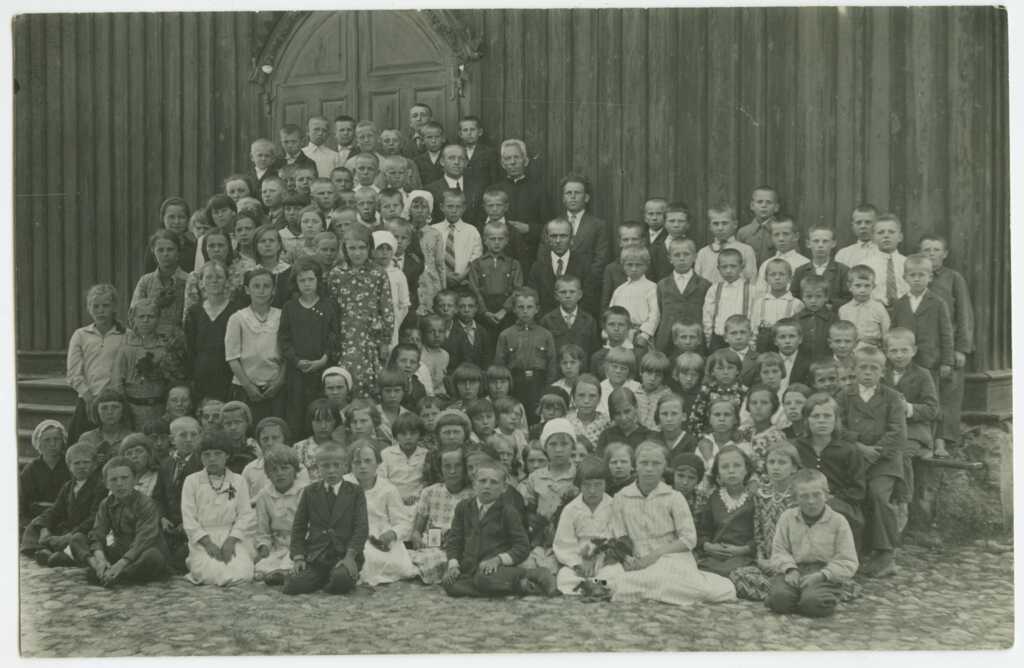
Vilniaus krašto lietuviai 1920–1939 m.Lietuvių švietimo draugijos „Rytas" Kabelių I, Kabelių II ir Šklėrių pradinių mokyklų mokinių ir mokytojų nuotrauka prie Kabelių bažnyčios.Partijos istorijos institutas, Nr. 49.1-49.