About the Church
The chapel's history begins in the 17th century, when the Discalced Carmelites began to look after the painting of the Blessed Virgin Mary, which in time became deeply venerated. In 1668 the Vilnius magistrate handed the painting over to the care of the Carmelite order and allowed a wooden chapel to be built above the gate, which was completed in 1671. Unfortunately this first chapel burned down in 1715, but a new masonry one was soon built in its place, which has survived to our own day.
A sacristy was built in 1764, and around 1789 the architect Pietro de Rossi designed the chapel's gallery and masonry staircase, intended to provide more convenient access to this holy place. The chapel was rebuilt in 1829, acquiring features of late Classicism. Another significant reconstruction took place in 1830–1840, when an arched gallery with second-floor windows was built next to the chapel.
In 1927–1932 the chapel was renovated, and restoration work carried out between 1976 and 1986 helped preserve the authenticity of this special place. One of the most important events in the chapel's history took place in 1993, when it was visited by Pope John Paul II.
The chapel's greatest treasure is the painting of the Blessed Virgin Mary, painted on eight joined oak boards. It is thought to have been created around 1520–1530, when Vilnius was encircled by its defensive wall. The painting was repainted at the end of the 17th and the beginning of the 18th century, and later, at the end of the 18th century, silver gilt covers were made for it. The painting has attracted considerable attention from artists; it was restored by Kanuty Rusiecki (around 1840) and by Professor J. Rutkowski (1927). The painting was especially honoured on 2 July 1927, when it was solemnly crowned.
The Chapel of the Blessed Virgin Mary, Mother of Mercy, of the Gate of Dawn in Vilnius still draws pilgrims and tourists today, offering not only a spiritual experience but also the chance to touch Lithuania's rich history.
Gallery and Resources
Archive captions are shown in Lithuanian.
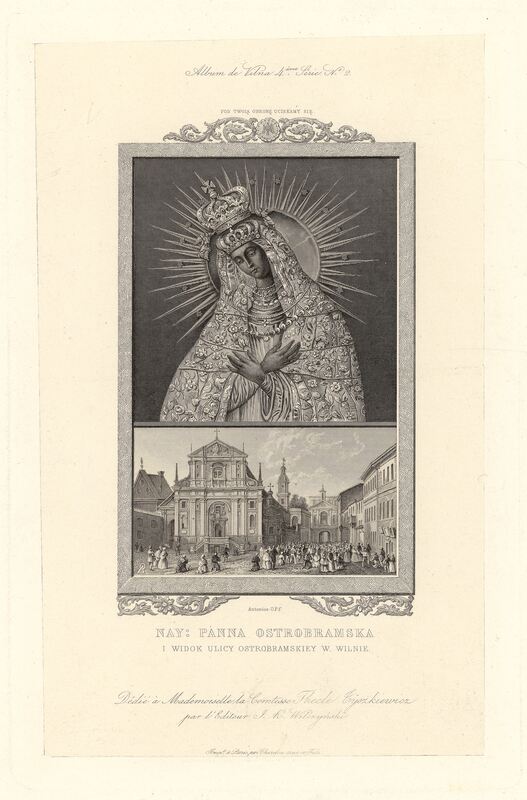
Raižinyje vaizduojamas, manoma, 1620–1630 metais sukurtas stebuklingu laikomas Švč. Mergelės Marijos Gailestingumo Motinos paveikslas, esantis Vilniaus Aušros Vartų koplyčios altoriuje. Smulkios raižysenos, detalaus piešinio dviejų dalių kūrinio viršutinėje dalyje įkomponuotas nuo XVII a. stebuklais garsėjęs Švč. Mergelės Marijos atvaizdas, o apatinėje dalyje – Vilniaus miesto vaizdas su Aušros Vartų koplyčia ir prie jos besimeldžiančiais žmonėmis. Nuo gaisrų ir karų saugojusi Švč. Mergelė Marija vaizduojama tamsiame fone su apkaustais – metalo drabužiais ir dviem karūnomis bei saule su žvaigždėmis – Nekaltai Pradėtosios atributais, reiškiančiais Dievo malonių perteklių. Raižinio rėmelį apatinės dalies kampuose ir viršutinės dalies centre puošia akanto lapų girliandos ir Marijos monograma. Švč. Mergelė Marija Gailestingumo Motina Lietuvoje laikoma viso krašto globėja, santarvės palaikytoja.
Iš Jono Kazimiero Vilčinskio „Vilniaus albumo“ (1846–1856). Serija IV, 2 sąs., graveris Antonis Oleščinskis (1794–1879). P. Galaunės įsigytas Vilniuje apie 1942 m.
Aprašė Miglė Banytė
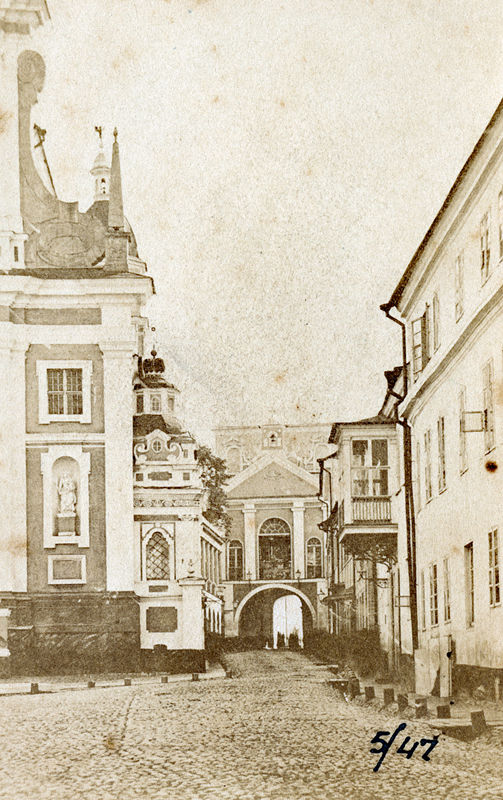
Nespalvota, vertikalaus formato, siužetinė nuotrauka. Nufotografuota Vilniaus Aušros Vartų Švč. M. Marijos, Gailestingumo Motinos koplyčia. Vaizdas nuo Didžiosios g. pusės XIX a. pab. I plane kairėje pusėje – Šv. Teresės bažnyčia, dešinėje – 2–3 aukštų dviaukščiai namai. II plane – Aušros Vartų koplyčia. Nuotrauka priklijuota prie balto kartono suapvalintais kampais. Reverse pieštuku lenkų k. įrašyta: „Ostrobrama“.
Aušros vartų koplyčia pastatyta XVIII a. vietoje sudegusios medinės. Joje esantis Švč. Mergelės Marijos paveikslas kaip stebuklingas garbinamas nuo XVII a.
Aušros vartų koplyčioje 1887 m. įvyko Kretingos dvarininko Aleksandro Tiškevičiaus (1864–1945) ir Marijos Puslovskos (1866–1939) santuoka.