About the Church
The building of the church began in 1621, when Discalced Carmelites who had come from Lublin, supported by the Vilnius mayor Ignotas Dubavičius and his brother Steponas, began to establish a monastery. The first buildings were modest, but within a few years the size of the complex had grown. In 1627 a wooden church was built, and in 1633 the Discalced Carmelites received support from the Pacas family, which helped create a grander building.
The church's most important patron was Steponas Kristupas Pacas, Chancellor of the Grand Duchy of Lithuania. The masonry church, whose facade has survived almost unchanged to our own time, was built at his expense. The design was created by Jonas Ulrichas, architect of the Radvila court, and the main facade was designed by the noted architect of the time, Constantino Tencalla. Construction of the church was completed in 1650, and just two years later the Bishop of Vilnius, Jurgis Tiškevičius, consecrated it.
In 1760 the church suffered a tragic fire, but the architect of the time, Johann Christoph Glaubitz, rebuilt it to his own design. The interior was decorated in the Rococo style, sculptures and frescoes were added, and a bell tower enriched the complex. This period left nine altars, which still delight visitors with their exceptional beauty.
In 1783 the Chapel of the Lord Jesus, also called the Pociejus Chapel, was built. It was financed by Mykolas Pociejus and became the burial place of the Pociejus family.
The church suffered great losses during Napoleon's wars of 1812, when French soldiers ravaged the interior. After the war the church was restored, but in 1844 the tsarist authorities closed the monastery. The Carmelites briefly returned almost a hundred years later, but after the Second World War their presence there ceased again.
In the second half of the 19th century a girls' school operated in the church, and at the beginning of the 20th century a girls' boarding house maintained by the Lithuanian Charity Society. In 1927–1929 the church was restored by the noted Lithuanian architect Juliusz Kłos, and later, in 1971–1976, the interior was repainted and restored.
Architecturally, St Teresa's Church is in the early Baroque style, with an asymmetrical plan and two chapels — the Pociejus Chapel and the Chapel of Our Lady of Good Counsel. The building is adorned with unique details in marble, granite and sandstone. Inside there are numerous works of art, among which the high altar, decorated with reliefs and sculptures, is especially valued.
Today the church is still active and open to visitors every day. Mass is celebrated in Lithuanian and Polish, reflecting Vilnius's multiculturalism and historical past.
Gallery and Resources
Archive captions are shown in Lithuanian.
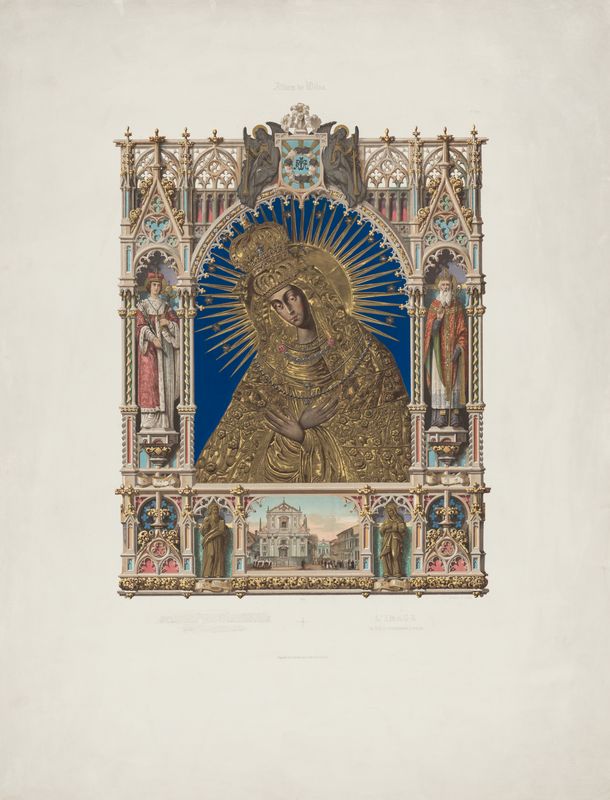
Kompozicijos centre mėlyname fone pavaizduotas Vilniaus Aušros Vartų koplyčios Švenčiausios Mergelės Marijos paveikslas, įkomponuotas puošniame ažūriniame gotikinių formų apvade. Abipus Švč. Mergelės Marijos paveikslo nišose patalpintos šventųjų statulos (kairioji – šv. Kazimiero). Po jos atvaizdu – ornamentiniais gotikos motyvais puošta horizontali juosta su auksinėmis šventųjų Onos ir Joakimo figūromis, o tarp jų, centre – architektūrinis peizažas. Jame vaizduojama barokinė Vilniaus Šv. Teresės bažnyčia bei Aušros Vartai, apsupti maldininkų. Kompozicijos piešinys lankstus, detalus, meistriškas. Spalvinis sprendimas kontrastingas, kiek margokas.
Aprašė Regina Urbonienė

Kompozicijos centre mėlyname fone pavaizduotas Vilniaus Aušros Vartų koplyčios Švenčiausios Mergelės Marijos paveikslas, įkomponuotas puošniame ažūriniame gotikinių formų apvade. Abipus Švč. Mergelės Marijos paveikslo nišose patalpintos šventųjų statulos (kairioji – šv. Kazimiero). Po jos atvaizdu – ornamentiniais gotikos motyvais puošta horizontali juosta su auksinėmis šventųjų Onos ir Joakimo figūromis, o tarp jų, centre – architektūrinis peizažas. Jame vaizduojama barokinė Vilniaus Šv. Teresės bažnyčia bei Aušros Vartai, apsupti maldininkų. Kompozicijos piešinys lankstus, detalus, meistriškas. Spalvinis sprendimas kontrastingas, kiek margokas.
Aprašė Regina Urbonienė