About the Church
The Holy Trinity Greek Catholic church in Vilnius is a unique monument of religious architecture which, over the centuries, has become an important historical and cultural focal point in Vilnius. This church is not only a house of prayer but also a place where the grandeur of different eras and the traditions of different peoples meet.
The history began as far back as 1347, when a wooden Orthodox church was built on the site of the present church. Over time the wooden structure gave way to a masonry church, endowed in 1514 by Konstantinas Ostrogiškis after his famous victory in the Battle of Orsha. This victory was a significant event in the history of both the Grand Duchy of Lithuania and Poland, and the building of the church became a symbol of that victory.
At the end of the 16th century the church was handed over to the Uniate Basilians. It is worth noting that the Basilians are a monastic order stemming from the Eastern Christian tradition; they played an important role in fostering the Uniate (Greek Catholic) faith and culture in Lithuania.
Time changed the church's fate. In 1821 it was closed and an Orthodox seminary was set up in its premises, which operated until 1919, when the building was handed over to the Catholic Society of St Vincent de Paul. During the Soviet period, from 1940 to 1991, the church did not function, but in the period after the restoration of independence it regained its former purpose and was handed over to the Greek Catholic community. In 1994 the church was assigned to the Order of St Josaphat's Basilians in Lithuania.
Architecturally, the church and its surroundings are no less impressive than its history. The church was built using plastered brick masonry, and although the Baroque style predominates, Renaissance features are also noticeable. Next to the church stands a monumental, square-plan Renaissance bell tower, which adds particular grandeur to the ensemble. The monastery courtyard is entered through ornate gates created by the famous Baroque master Christoph Glaubitz.
Services in this church are held in Ukrainian, which testifies to deep and strong ties with the Ukrainian community. It is also a reminder that Vilnius has always been a multicultural city, home to different peoples and their traditions.
On visiting this church, one can sense not only an atmosphere of spirituality but also touch a rich history that speaks of great struggles, cultural change and the path of people's faith.
The history began as far back as 1347, when a wooden Orthodox church was built on the site of the present church. Over time the wooden structure gave way to a masonry church, endowed in 1514 by Konstantinas Ostrogiškis after his famous victory in the Battle of Orsha. This victory was a significant event in the history of both the Grand Duchy of Lithuania and Poland, and the building of the church became a symbol of that victory.
At the end of the 16th century the church was handed over to the Uniate Basilians. It is worth noting that the Basilians are a monastic order stemming from the Eastern Christian tradition; they played an important role in fostering the Uniate (Greek Catholic) faith and culture in Lithuania.
Time changed the church's fate. In 1821 it was closed and an Orthodox seminary was set up in its premises, which operated until 1919, when the building was handed over to the Catholic Society of St Vincent de Paul. During the Soviet period, from 1940 to 1991, the church did not function, but in the period after the restoration of independence it regained its former purpose and was handed over to the Greek Catholic community. In 1994 the church was assigned to the Order of St Josaphat's Basilians in Lithuania.
Architecturally, the church and its surroundings are no less impressive than its history. The church was built using plastered brick masonry, and although the Baroque style predominates, Renaissance features are also noticeable. Next to the church stands a monumental, square-plan Renaissance bell tower, which adds particular grandeur to the ensemble. The monastery courtyard is entered through ornate gates created by the famous Baroque master Christoph Glaubitz.
Services in this church are held in Ukrainian, which testifies to deep and strong ties with the Ukrainian community. It is also a reminder that Vilnius has always been a multicultural city, home to different peoples and their traditions.
On visiting this church, one can sense not only an atmosphere of spirituality but also touch a rich history that speaks of great struggles, cultural change and the path of people's faith.
Gallery and Resources
Archive captions are shown in Lithuanian.
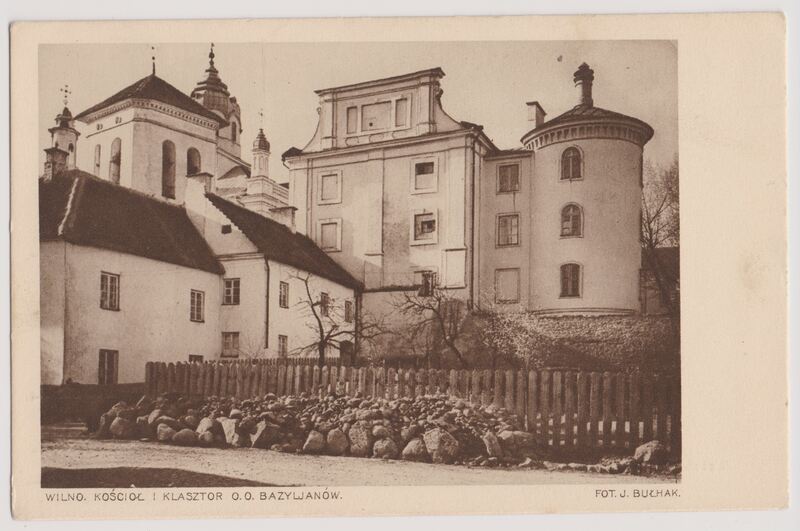
Atvirukas. Vilnius. „WILNO. KOSCIOL I KLASZTOR O.O. BAZYLJANOW / FOT. J. BULHAK“. Išleido Lenkijos Geležinkeliečių Sąjungos „Ruch“ knygynas Varšuvoje. Vaizdas rudos spalvos. Atviruke Vilniaus Švč. Trejybės Graikų apeigų katalikų bažnyčia.