About the Church
Onuškis Church of Sts Philip and James the Apostles is one of those Lithuanian churches whose history is full of colourful events and changes. Situated in the quiet town of Onuškis, it reflects not only the religious but also the cultural development of the area.
The church's history begins as early as the 16th century. Although the first record of it dates from 1526, it may be assumed that it was built somewhat earlier. In those days the church was very modest and poor, as attested by the hearth-tax rates – in 1559 it had a mere 9 households (hearths).
In 1562 this wooden church burned down, but was rebuilt already six years later. In the late 16th century Onuškis church possibly belonged to the Evangelical Reformed, but in 1611 it was returned to the Catholics. Unfortunately, in 1655 the church suffered fire again and was restored only after almost two decades.
By the end of the 18th century the church was already completely decayed. A minor repair carried out in 1820 did not save the building, and in 1823 it collapsed. The present church rose in 1823-1829 through the efforts of the estate owner K. Šetkevičius. It is built of brick and stone masonry, and its style is typical of late Classicism with Romanticist features.
This church is a hall church of rectangular plan, with an impressive Doric-columned portico. Its interior is divided into three aisles, supported by four pairs of columns. The churchyard is enclosed by a stone and brick fence, and a wooden bell tower stands within it. Interestingly, in 1993 the remains of Donatas Malinauskas, a signatory of the Act of Independence of Lithuania, and his relatives, brought from Altai, were buried in the churchyard.
From 1927-1939 the parish priest was Kazimieras Čibas, who took care of the parishioners' sobriety and their religious and cultural advancement. Later, from 1939-1953, Nikodemas Švogžlys-Milžinas served here.
The church is truly unique in its architecture and historical context. It has become not only an important religious centre but also a hub of culture, adorned by a rich legacy of the past and a living present-day community.
The church's history begins as early as the 16th century. Although the first record of it dates from 1526, it may be assumed that it was built somewhat earlier. In those days the church was very modest and poor, as attested by the hearth-tax rates – in 1559 it had a mere 9 households (hearths).
In 1562 this wooden church burned down, but was rebuilt already six years later. In the late 16th century Onuškis church possibly belonged to the Evangelical Reformed, but in 1611 it was returned to the Catholics. Unfortunately, in 1655 the church suffered fire again and was restored only after almost two decades.
By the end of the 18th century the church was already completely decayed. A minor repair carried out in 1820 did not save the building, and in 1823 it collapsed. The present church rose in 1823-1829 through the efforts of the estate owner K. Šetkevičius. It is built of brick and stone masonry, and its style is typical of late Classicism with Romanticist features.
This church is a hall church of rectangular plan, with an impressive Doric-columned portico. Its interior is divided into three aisles, supported by four pairs of columns. The churchyard is enclosed by a stone and brick fence, and a wooden bell tower stands within it. Interestingly, in 1993 the remains of Donatas Malinauskas, a signatory of the Act of Independence of Lithuania, and his relatives, brought from Altai, were buried in the churchyard.
From 1927-1939 the parish priest was Kazimieras Čibas, who took care of the parishioners' sobriety and their religious and cultural advancement. Later, from 1939-1953, Nikodemas Švogžlys-Milžinas served here.
The church is truly unique in its architecture and historical context. It has become not only an important religious centre but also a hub of culture, adorned by a rich legacy of the past and a living present-day community.
Gallery and Resources
Archive captions are shown in Lithuanian.
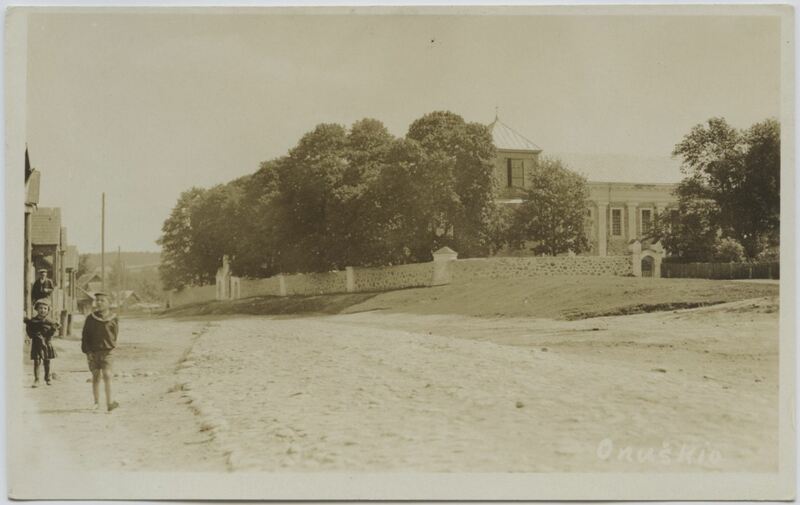
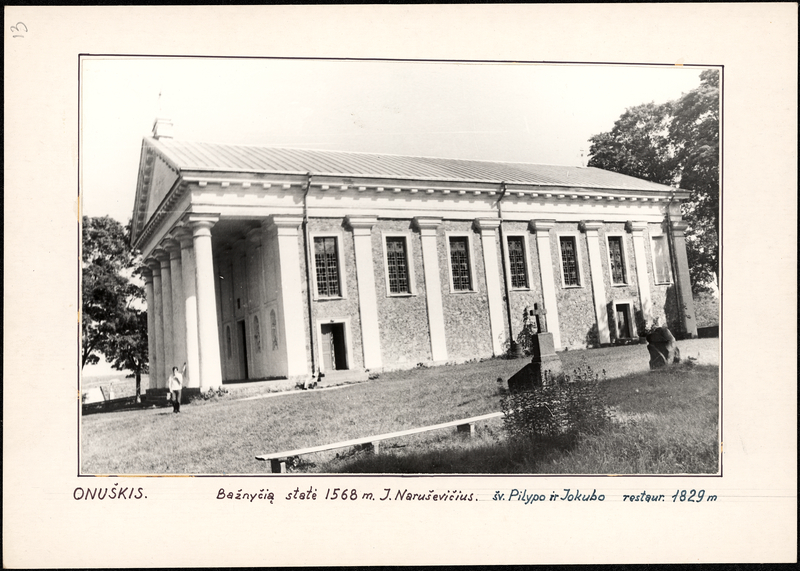
Onuškio Šv. apaštalų Pilypo ir Jokūbo bažnyčia. Fotografijos aprašymas ant pasporto: „ONUŠKIS. Bažnyčią statė 1568 m. J. Naruševičius. šv. Pilypo ir Jokubo restaur. 1829 m“.