About the Church
The Church of the Holy Trinity in Stakliškės is one of the most impressive monuments of Baroque architecture in Lithuania. It stands in the heart of the village of Stakliškės and has been an irreplaceable part of local spiritual life since the 17th century.
The first church in Stakliškės was built before 1586, and it was endowed by the surrounding manors and villages, such as Kielioniai, Kvedariškiai and Virkininkai. However, during the war with Muscovy, in 1655, the church was burned down by the Russian army. Nevertheless, faith and the community's strength allowed it to recover — a new church began to be built as early as 1663 and was completed in 1674.
The present masonry church was built in 1770–1776 on the initiative of the starosta of Stakliškės, Juozapas Teodoras Boufalas-Daraškevičius. It was consecrated by the auxiliary bishop of Vilnius, Tomas Zenkavičius. But its history was not easy: in 1818 a storm destroyed the church's roof and towers, which remained unrepaired for a long time.
This church's architecture is a fine example of Late Baroque. It has a cross-shaped plan, with two three-tiered towers on the main facade and a semicircular apse. Inside the church one finds a rich Baroque interior, comprising a short nave, a transept with side chapels, a central altar and valuable works of art.
The church is also renowned for its unique decorations and valuable works of art, including 17th–18th-century paintings and sculptures, liturgical items and an organ. Particularly worth mentioning are the painting “The Holy Trinity” and the sculpture “The Crucified Christ”.
The churchyard of Stakliškės is enclosed by a plastered masonry wall, and today a sculpture commemorating the tenth anniversary of Lithuania's independence stands in the nearby 18th-century roadside shrine.
The Church of the Holy Trinity in Stakliškės not only reflects the rich religious and cultural history of Lithuania but is also a constantly living community centre, where the most important spiritual and cultural events take place. It is a place where past and present come together, where every corner tells of the sacrifices made for faith and for the well-being of the community.
The first church in Stakliškės was built before 1586, and it was endowed by the surrounding manors and villages, such as Kielioniai, Kvedariškiai and Virkininkai. However, during the war with Muscovy, in 1655, the church was burned down by the Russian army. Nevertheless, faith and the community's strength allowed it to recover — a new church began to be built as early as 1663 and was completed in 1674.
The present masonry church was built in 1770–1776 on the initiative of the starosta of Stakliškės, Juozapas Teodoras Boufalas-Daraškevičius. It was consecrated by the auxiliary bishop of Vilnius, Tomas Zenkavičius. But its history was not easy: in 1818 a storm destroyed the church's roof and towers, which remained unrepaired for a long time.
This church's architecture is a fine example of Late Baroque. It has a cross-shaped plan, with two three-tiered towers on the main facade and a semicircular apse. Inside the church one finds a rich Baroque interior, comprising a short nave, a transept with side chapels, a central altar and valuable works of art.
The church is also renowned for its unique decorations and valuable works of art, including 17th–18th-century paintings and sculptures, liturgical items and an organ. Particularly worth mentioning are the painting “The Holy Trinity” and the sculpture “The Crucified Christ”.
The churchyard of Stakliškės is enclosed by a plastered masonry wall, and today a sculpture commemorating the tenth anniversary of Lithuania's independence stands in the nearby 18th-century roadside shrine.
The Church of the Holy Trinity in Stakliškės not only reflects the rich religious and cultural history of Lithuania but is also a constantly living community centre, where the most important spiritual and cultural events take place. It is a place where past and present come together, where every corner tells of the sacrifices made for faith and for the well-being of the community.
Gallery and Resources
Archive captions are shown in Lithuanian.

Stakliškių Švč. Trejybės bažnyčia. Prienų r. 1999 m.
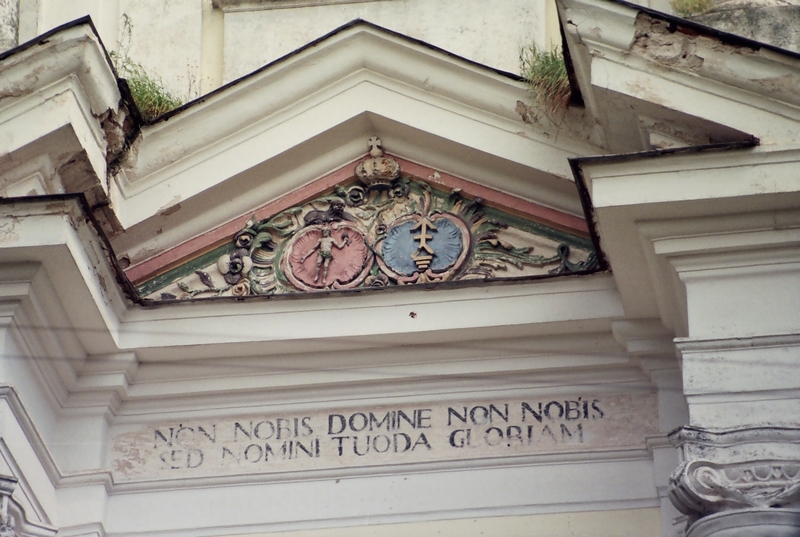
Stakliškių Švč. Trejybės bažnyčios fasado puošybos elementai. Prienų r. 1999 m.