About the Church
Today's church stands near the site of the former shrine, from where a wonderful view opens onto the valley of the Neris river. This wooden church resembles a single-storey dwelling house and was built in 1945, after the earlier church burned down during the Second World War.
However, the history of Karmėlava St Anne's Church goes back much further. The first church here was built around 1521, and in 1529 the Karmėlava elder Simonas Sirutis granted it land. Later, in 1531, Jurgis Andriuškevičius donated the Andruškonys farmstead, on the other side of the Neris, to the church. Unfortunately, in 1655 the Muscovite army destroyed the original church, and it was not rebuilt until 1768.
Interestingly, in the 18th century sermons in the church were preached in two languages, Polish and Lithuanian. However, by the end of the 19th century Lithuanian-language services had become rare. Only at the beginning of the 20th century did parishioners again start demanding more services in their native language. But owing to disagreements between Polish- and Lithuanian-speaking parishioners, the church was closed at the end of 1909.
After the First World War, the Lithuanian Catholic Women's Society founded a junior agricultural school in Karmėlava, whose activities also helped to strengthen the community. A new wooden church, designed by the renowned architect Vladimiras Dubeneckis, was built in 1919–1921. This church was considerably renovated between 1937 and 1939, but the hardships of wartime did not spare it from destruction.
The foundations of the old church and its masonry gates, recognised as an architectural monument, can still be seen in the churchyard. It is also worth mentioning that beside the new church stands the Mažasis Ungutas deportees' memorial and a gravestone monument to Fr J. Ruibys.
All this history testifies to the importance of Karmėlava St Anne's Church not only as a religious but also as a cultural and historical symbol. Its surviving elements and the efforts of the religious community over the centuries show how important this place has been, and still is, to the local people.
Gallery and Resources
Archive captions are shown in Lithuanian.
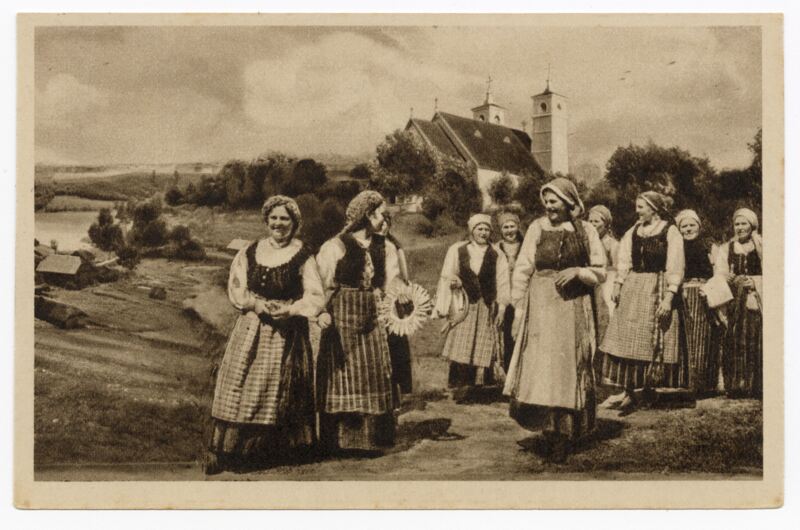
Fotoatvirukas „Erntefest – Pabaigtuvės“. Atvirukas su nevienodo pločio šviesiomis paraštėmis, nuotraukos reprodukcija spausdinta juodu rudo atspalvio dažu. Reprodukcijoje pavaizduotos besišypsančios moterys su tautiniais kostiumais; fone matosi Karmėlavos Šv. Onos bažnyčia; kairėje tekanti Neris. Viena iš moterų laiko nupintą vainiką iš varpų. Manoma, kad švenčiama rugiapjūtės pabaiga. Atviruko reverse žaliu dažu atspausdinta: dešinėje skirtingo ilgio penkios punktyrinės linijos ir viena pastorinta adresui ir stačiakampis pašto ženklui, bei tekstas kairėje apačioje – „Erntefest – Pabaigtuvės“ ir per vidurį – „Spindulys“; kita kryptimi (vertikaliai) centre – „Verlag P/B „VIKTORIA“, Kaunas, Laisvės al. 42. Tel. 23332.“ ir logotipas su raide „V“ apskritame dviejų šakelių vainike. Kairėje pusėje ranka grafito pieštuku parašyta – „Karmėlava, / 1944 m“.

Nuotrauka "Karmėlavos troba su Šv. Onos bažnyčios bokšto fragmentu"; vermachto kario fotografija; apie 1942 m.; pirkta Vokietijoje. Nuotraukos centre stovi medinis pastatas dengtas šiaudais, už jo kito pastato galo fragmentas už kurio tolumoje matosi bažnyčios bokšto fragmentas. Pirmame plane apatiniame dešiniajame kampe stovi vyras su kostiumu įkomponuota tik vršutinė dalis (be kojų). Vyras nusisukęs nuo kameros žiūri į dešinę. Nuotraukos reverse du skirtingi įrašai ranka: grafito pieštuku nelygiai "Karmėlava, bažnyčia / apie 1942 m."; apatiniame kairiajame kampe mėlynu pieštuku dailia rašysena į dvi eilutes "Ferme Lithuaniene / environs de Kaunas.". Karmėlavos bažnyčia pastatyta 1919–1921 m. pagal Vladimiro Dubeneckio projektą. Per II Pasaulinį karą 1944 m. bažnyčia sudegė, išlikę tik pamatai.