About the Church
The Church of St Francis Xavier in Kaunas is not only one of the principal landmarks of Kaunas's Old Town but also a story of the twists of Lithuanian history and its cultural change. This Late Baroque church, also known as the Kaunas Jesuit Church, adorns Rotušės Square and stands beside the famous Kaunas Jesuit monastery.
The church's history begins in the early 17th century, when the Kojalavičius-Vijūkas brothers donated a masonry house in Kaunas to the Jesuits. As early as 1643 a Jesuit residence was established here and the Chapel of St Stanislaus Kostka was built. Unfortunately, both buildings were destroyed in 1655. But the Jesuits did not give up, and in 1660 they began building a wooden chapel and renovated their residence.
The Jesuits also took an active interest in education – a four-grade school running from 1646 developed over time into a full college. Poetics and rhetoric were taught there, and from 1725 also philosophy. It had its own theatre and orchestra, and from 1761 it became a full college. In 1819–1823 the celebrated poet Adam Mickiewicz taught at this school.
In 1666 the Jesuits decided to build a masonry church, but the construction was dogged by misfortune: in 1668 the scaffolding burned down, and in 1732 a fire ravaged not only the church but also the college and the monastery. However, thanks to the efforts of Father Pranciškus Milvydas, the work was completed in 1720, and the towers were built in 1725. In the second half of the 18th century the church already had as many as 12 altars decorated with imitation marble.
In time, however, the church's fate changed. In 1812 Napoleon's army badly devastated the church. Later, in 1824, it was converted into an Orthodox church by order of Emperor Alexander I and renamed the Alexander Nevsky Cathedral. An iconostasis then appeared in the interior, with a painting at its centre that had been painted in Florence in 1661.
In the 20th century the church changed function more than once. After the First World War it was returned to the Jesuits, and services began to be held there again in 1924. Between the wars a grammar school, a cinema hall and a gymnastics hall operated by the church. Unfortunately, during the Second World War the church was closed again and its buildings were adapted for general-education and technical schools. Only after 1990 was the church returned to the faithful.
Today the Church of St Francis Xavier is an inseparable part of the city. Its facade, with striking cornices, pilasters and niches, reflects the beauty of Baroque architecture. Two elegant towers lend an impression of lightness and solemnity. Inside, the three-aisled space invites reflection and a sense of the spirit of history.
It is a place where the past merges with the present, where every detail recalls the passage of centuries and people's efforts to preserve their faith, culture and heritage.
The church's history begins in the early 17th century, when the Kojalavičius-Vijūkas brothers donated a masonry house in Kaunas to the Jesuits. As early as 1643 a Jesuit residence was established here and the Chapel of St Stanislaus Kostka was built. Unfortunately, both buildings were destroyed in 1655. But the Jesuits did not give up, and in 1660 they began building a wooden chapel and renovated their residence.
The Jesuits also took an active interest in education – a four-grade school running from 1646 developed over time into a full college. Poetics and rhetoric were taught there, and from 1725 also philosophy. It had its own theatre and orchestra, and from 1761 it became a full college. In 1819–1823 the celebrated poet Adam Mickiewicz taught at this school.
In 1666 the Jesuits decided to build a masonry church, but the construction was dogged by misfortune: in 1668 the scaffolding burned down, and in 1732 a fire ravaged not only the church but also the college and the monastery. However, thanks to the efforts of Father Pranciškus Milvydas, the work was completed in 1720, and the towers were built in 1725. In the second half of the 18th century the church already had as many as 12 altars decorated with imitation marble.
In time, however, the church's fate changed. In 1812 Napoleon's army badly devastated the church. Later, in 1824, it was converted into an Orthodox church by order of Emperor Alexander I and renamed the Alexander Nevsky Cathedral. An iconostasis then appeared in the interior, with a painting at its centre that had been painted in Florence in 1661.
In the 20th century the church changed function more than once. After the First World War it was returned to the Jesuits, and services began to be held there again in 1924. Between the wars a grammar school, a cinema hall and a gymnastics hall operated by the church. Unfortunately, during the Second World War the church was closed again and its buildings were adapted for general-education and technical schools. Only after 1990 was the church returned to the faithful.
Today the Church of St Francis Xavier is an inseparable part of the city. Its facade, with striking cornices, pilasters and niches, reflects the beauty of Baroque architecture. Two elegant towers lend an impression of lightness and solemnity. Inside, the three-aisled space invites reflection and a sense of the spirit of history.
It is a place where the past merges with the present, where every detail recalls the passage of centuries and people's efforts to preserve their faith, culture and heritage.
Gallery and Resources
Archive captions are shown in Lithuanian.
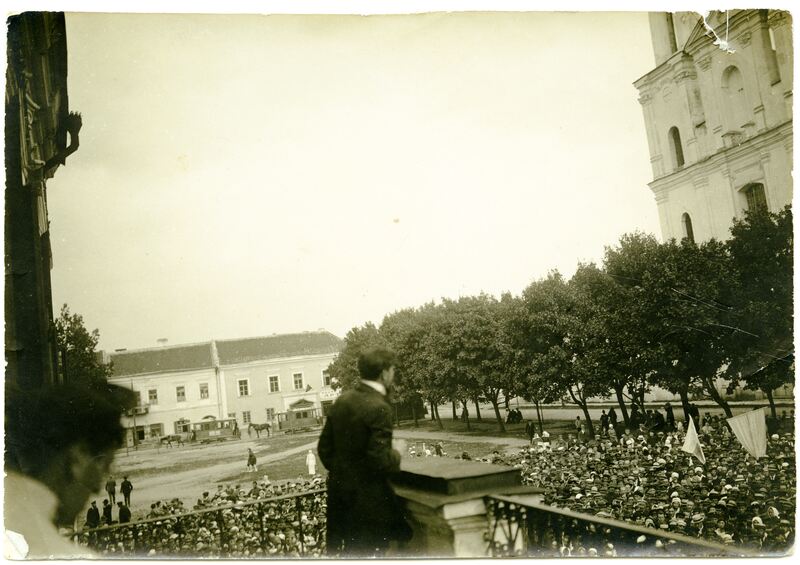
Vaizdas iš Kauno rotušės. Balkone stovi vyras, matomas iš užpakalio, sakantis kalbą šventės ar mitingo dalyviams apačioje. Dešinėje, už medžių matosi šv. Pranciškaus Ksavero (Jėzuitų) bažnyčia. Kairėje, aikštės pakraštyje matosi du arklinio tramvajaus (konkės) vagonai. Iš Vytauto Povilo Jurkšto rinkinių
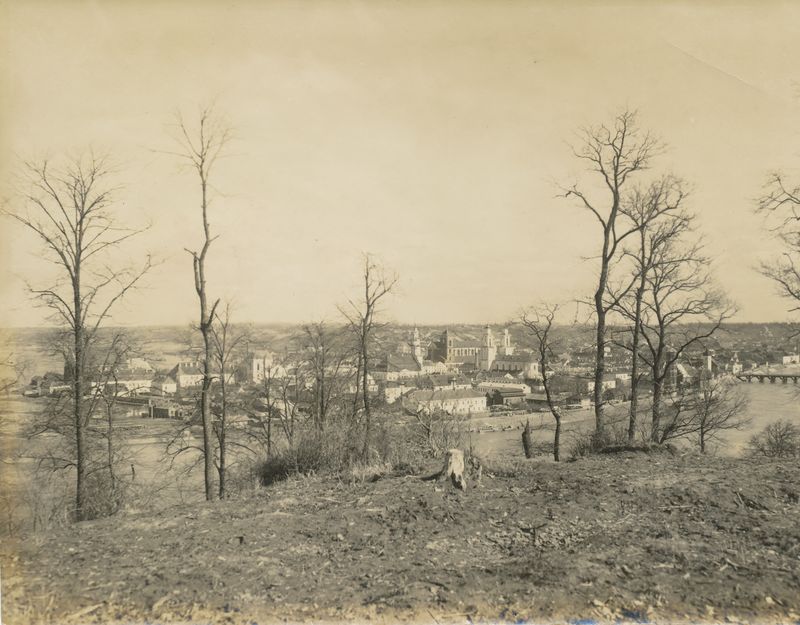
Horizontalaus formato nespalvota fotografija. Vaizdinėje pusėje – panoraminis vaizdas nuo Aleksoto kalno į Kauno senamiestį. Dešinėje pusėje matomas vokiečių atstatytas medinis tiltas per Nemuną, Kauno Švč. Mergelės Marijos Ėmimo į dangų bažnyčia (Vytauto Didžiojo bažnyčia). Centre matoma Kauno šv. Pranciškaus Ksavero bažnyčia (Kauno Jėzuitų bažnyčia), vienas iš bažnyčios bokštų apgadintas.