About the Church
The church is located in the Old Town, on the right bank of the Nemunas, beside the Vytautas the Great Bridge. Its history goes back to around the year 1400, when the Grand Duke of Lithuania Vytautas, having escaped drowning after a battle with the Tatars at the Vorskla River, vowed to build a church to the Virgin Mary. Thus this wonderful Gothic church was born, which initially belonged to the Franciscans.
Over the centuries the Church of Vytautas the Great suffered numerous historical upheavals. It was plundered and ravaged by Swedish and Russian troops in the 17th century, and was rebuilt again at the beginning of the 18th century. In 1812 the French Emperor Napoleon turned it into an arms depot. As the French retreated, the church was ravaged and set on fire. Later still, in 1831–1832, it became a food store for the Russian army and was closed, while the monastery buildings became a police station and a military office.
In the mid-19th century the church was converted into an Orthodox church, and an Eastern-style interior was installed inside it. In time the church again changed its use: during the First World War the German army turned it into a potato store. It was returned to the Catholic community of Kaunas only in 1919 and was blessed by Prelate Adomas Dambrauskas-Jakštas. From 1930, to mark the jubilee year of Vytautas the Great, the church began to be named after him.
Architecturally the church stands out for its thick walls, which in places reach as much as 1.6 metres. Authentic Gothic vaults survive in the chancel and in the southern chapel. The brickwork of the walls is an example of particular beauty and craftsmanship, the bricks laid to form striking patterns out of black overburnt bricks.
Among the church's rectors were some very famous people. One of them was the priest and writer Juozas Tumas-Vaižgantas, who not only looked after the church but also invited well-known artists to decorate its interior. Thanks to him the church became a hub of culture, and Vaižgantas himself was buried here.
Looking at this church, it is impossible not to be captivated by its rich history and architecture. It is not only a house of prayer but also a living historical monument, recalling various eras, their joys and their hardships.
Gallery and Resources
Archive captions are shown in Lithuanian.
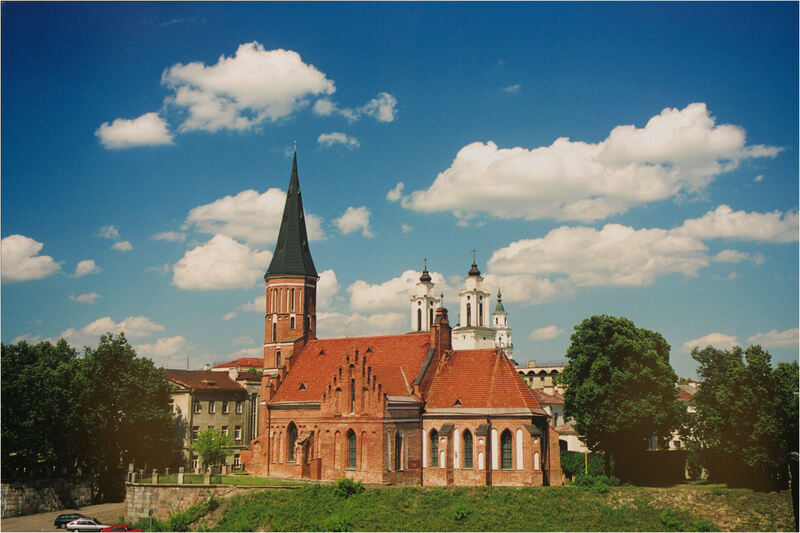
Nuotrauka. Kauno Vytauto Didžiojo Švč. Mergelės Marijos Ėmimo į dangų bažnyčia. Joje Ričardas Mikutavičius klebonavo 1989–1992 m.
Tai seniausia bažnyčia Kaune, vienintelė Lietuvoje gotikos stiliaus, turinti kryžiaus pavidalo planą. Pastatyta apie 1400 metus, priklausė pranciškonams. Manoma, kad XV amžiaus pabaigoje pastatytas bažnyčios bokštas. Nuotraukoje matosi iš dešiniojo šono, raudonų plytų mūras, bokštas su kryžium, arkiniai langai. Fotografuota Zenono Baltrušio. 2005 m. Kaunas.

Horizontalaus formato nespalvota fotografija. Vaizdinėje pusėje – panoraminis vaizdas nuo Aleksoto kalno į Kauno senamiestį. Dešinėje pusėje matomas vokiečių atstatytas medinis tiltas per Nemuną, Kauno Švč. Mergelės Marijos Ėmimo į dangų bažnyčia (Vytauto Didžiojo bažnyčia). Centre matoma Kauno šv. Pranciškaus Ksavero bažnyčia (Kauno Jėzuitų bažnyčia), vienas iš bažnyčios bokštų apgadintas.