About the Church
The earliest mentions of a church in Taujėnai are found as far back as 1669, when a chaplaincy at Taujėnai is recorded. However, the masonry church seen today has a longer and more complicated history. A wooden church was built in 1785, but it did not survive long – it burned down in 1845. This tragedy did not destroy the spirit of the local faithful: in 1854 the owner of the Taujėnai manor obtained permission to resume construction work begun three decades earlier, and in 1858 the building of the masonry church, to the design of the architect Šurinas, was completed.
This church stands out for its Classicist architecture. It is a rectangular-plan, towerless, single-nave structure, surrounded by a metal churchyard fence. In addition, a masonry bell tower stands in the churchyard, adding to the grandeur and harmony of the whole complex.
It is interesting to note that although the church has no towers, its architecture is dominated by the classical lines and ornamentation characteristic of the style. Such architectural choices not only give the church aesthetic beauty but also symbolise strength and permanence.
The gallery and decorations inside bear witness to the rich history of this church and its cultural significance for the local community. One of the most memorable elements of the interior is the portrait of the writer Marija Pečkauskaitė–Šatrijos Ragana, which undoubtedly draws visitors' attention and encourages them to recall Lithuania's literary heritage.
Taujėnai's Church of the Exaltation of the Holy Cross is not only a religious but also a cultural centre, whose history and architecture attract both the faithful and lovers of art and history. It is a place where the fates of many generations intertwine, and where every visit becomes a journey through the ages.
Gallery and Resources
Archive captions are shown in Lithuanian.

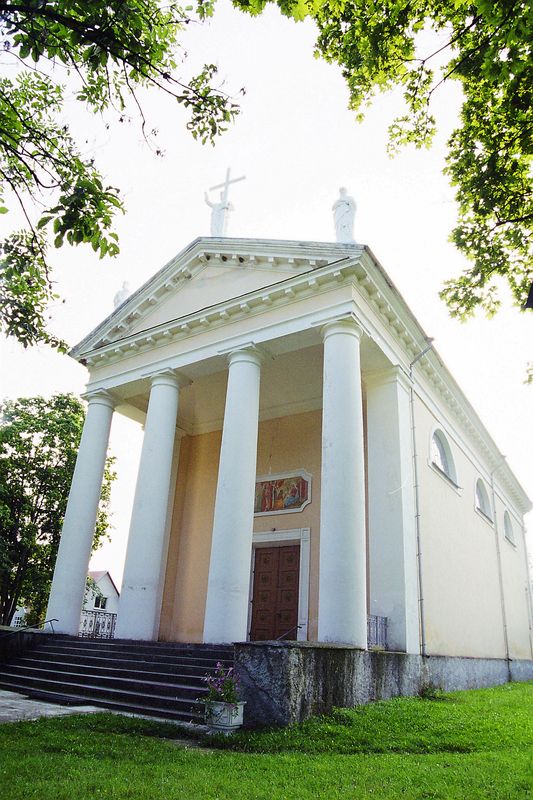
Spalvota, vertikalaus formato nuotrauka. Taujėnų Šv. Kryžiaus Išaukštinimo bažnyčia, Ukmergės g. 28, Taujėnų mstl., Taujėnų sen., Ukmergės r. sav. Vaizdas iš šiaurės rytų pusės. Fotografas Jonas Šimkus, Kretinga, 2001 m.
Bažnyčia tinkuoto mūro, klasicistinė, stačiakampio plano, bebokštė, vienanavė, su trikampį frontoną laikančiu keturių kolonų portiku. Pastatas atspindi graikų dorėnų stilių.
Pastatyta Taujėnų dvarininkų Karolio ir Konstantino Radvilų lėšomis 1854–1858 m. pagal architekto Šurino projektą, gavus 1854 m. leidimą baigti prieš 30 metų pradėtą statyti mūrinę bažnyčią. Stovi Taujėnų miestelyje prie Ukmergės–Panevėžio kelio, Mūšios upelio dešiniajame krante. Šventoriaus tvora metalinė. Jame stovi mūrinė varpinė.
Priklauso Motiejaus Valančiaus vyskupavimo laikotarpiu (1850–1875) pastatytoms ar restauruotoms bažnyčioms.
Aprašymą parengė Algirdas Čėsna, 2014-06-05.