About the Church
The Church of the Blessed Virgin Mary in Miežiškiai is a special place where a long history and architectural beauty intertwine. This Gothic Revival church stands in the beautiful town of Miežiškiai, near the left bank of the Nevėžis. Interestingly, the building of this church drew the attention and efforts of many residents and parishioners.
A chapel in Miežiškiai is first mentioned as early as the 17th century, specifically in 1669 and 1744. In 1782 the manor owner Pšeciševskis decided to renew the local house of prayer and built a wooden chapel. Over time this small chapel became part of the Panevėžys parish, and its significance to the community kept growing.
In the 19th century Miežiškiai again saw great change. In 1864 a presbytery was built, and two years later a masonry churchyard wall. Several more important buildings followed: in 1885 a larger presbytery went up, and in 1891 buildings for the church's staff.
In the early 20th century the most ambitious project began – the building of a masonry church. Although the authorities at first would not allow work to start until the required sum of money had been raised, a parish was founded in 1909, and already in 1911, on the initiative of the priest T. Pranaševičius, construction of the present church began. Unfortunately, these plans were disrupted by the First World War. Nevertheless, between 1916 and 1920, thanks to the parish priest Antanas Paurys, the church was completed, and in 1921 it was consecrated by Bishop Pranciškus Karevičius.
The church is notable for its distinctive Gothic Revival architectural style. Red brick masonry gives it an impression of solidity and grandeur. The church is cruciform in plan, with one main tower and several smaller turrets adorning its facade. The masonry churchyard wall with metal railings also adds to the overall harmony of the appearance.
Despite its turbulent history and numerous changes, the Church of the Blessed Virgin Mary in Miežiškiai remains the spiritual centre of the local community and draws visitors with its architectural beauty and rich history.
A chapel in Miežiškiai is first mentioned as early as the 17th century, specifically in 1669 and 1744. In 1782 the manor owner Pšeciševskis decided to renew the local house of prayer and built a wooden chapel. Over time this small chapel became part of the Panevėžys parish, and its significance to the community kept growing.
In the 19th century Miežiškiai again saw great change. In 1864 a presbytery was built, and two years later a masonry churchyard wall. Several more important buildings followed: in 1885 a larger presbytery went up, and in 1891 buildings for the church's staff.
In the early 20th century the most ambitious project began – the building of a masonry church. Although the authorities at first would not allow work to start until the required sum of money had been raised, a parish was founded in 1909, and already in 1911, on the initiative of the priest T. Pranaševičius, construction of the present church began. Unfortunately, these plans were disrupted by the First World War. Nevertheless, between 1916 and 1920, thanks to the parish priest Antanas Paurys, the church was completed, and in 1921 it was consecrated by Bishop Pranciškus Karevičius.
The church is notable for its distinctive Gothic Revival architectural style. Red brick masonry gives it an impression of solidity and grandeur. The church is cruciform in plan, with one main tower and several smaller turrets adorning its facade. The masonry churchyard wall with metal railings also adds to the overall harmony of the appearance.
Despite its turbulent history and numerous changes, the Church of the Blessed Virgin Mary in Miežiškiai remains the spiritual centre of the local community and draws visitors with its architectural beauty and rich history.
Gallery and Resources
Archive captions are shown in Lithuanian.
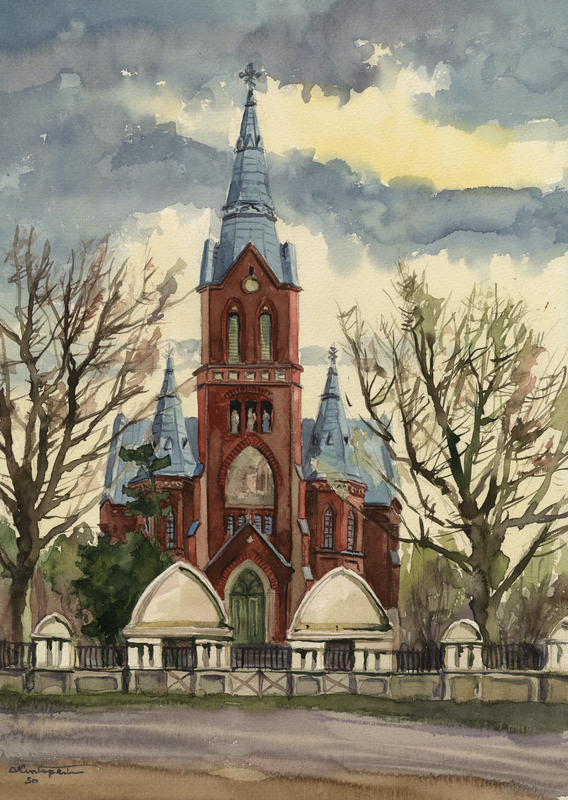
Kompozicijoje – Miežiškių Švč. Mergelės Marijos bažnyčia.
Signuotas averso kairėje akvarele: „AKristopaitis / 80“ ir reverse pieštuku: „MIEŽIŠKIAI / 1980. IV. 19 / Statyta 1916-20m.“.