About the Church
The church's history began as far back as the 15th century, when it was founded by the castellan of Vilnius, Kristinas Astikas. The church's construction date is associated with 1406, although its actual building in masonry took place in the first half of the 15th century. The church was built following the then very popular model of a square-plan, three-aisled hall church with a five-sided apse, reflecting the Gothic style.
In 1522 several plots of land were donated to the church, and a Catholic church is already mentioned in 1553. However, in the second half of the 16th century, when Vyžuonos came into the ownership of Evangelical Reformed owners, the church passed into their hands. During the Reformed period several significant events took place here: in 1611 Mikalojus Radvila was buried in the church, and in 1641 Prince Kristupas Radvila the Younger.
In 1656, by a ruling of the Ukmergė castle court, the church was returned to the Catholics. From then on the church and parish changed, being constantly renovated and extended. A presbytery was built in 1736, and a parish school is mentioned from 1777. By the end of the 18th century the church already had two side chapels and a vestibule.
During the period of tsarist Russia, in 1796, the church burned down in a fire that swept the town, but it was rebuilt a few years later. In the 19th century, on the initiative of parish priest Antanas Drukteinis, the church was rebuilt and enlarged, and a new organ and Stations of the Cross were installed.
In the 20th century, too, the church's history is full of events. During the First World War the bells were taken away to Russia, and after the war the church was renovated and revived once more. Parish priest Aleksandras Mileika actively took care of the church's repair and preservation, but in 1941 he was arrested and exiled to Siberia. The Second World War also left its mark – in 1944 the glass fell out of the church windows.
Architecturally the church has a Latin-cross plan, with a three-sided apse and a single tower. Inside it has three aisles, covered by cross vaults. The churchyard wall is made of stone masonry, and set into the wall of the rear facade are relics of historic significance – the head of the grass-snake Vyžas and a Swedish cannonball.
The church of St George at Vyžuonos, having lived through numerous historical changes and hardships, today stands as a symbol of faith and history, telling of the greatness of Lithuania's past and the determination of its people to preserve their cultural heritage.
Gallery and Resources
Archive captions are shown in Lithuanian.
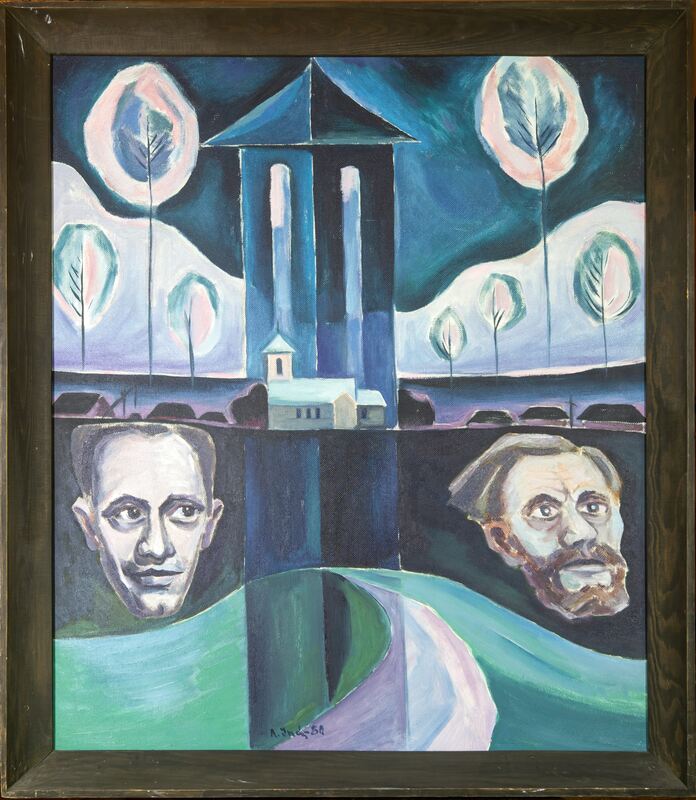
Dailininko Algirdo Jono Indrašiaus (1937–2024) paveikslas skirtas dviejų vyžuoniškių rašytojų: prozininko Broniaus Radzevičiaus (1940–1980) ir poeto, literatūros kritiko Antano Masionio (1941–1974) atminimui. Jis signuotas paveikslo apačioje: „A. Indr 80“. Paveikslas įrėmintas masyviame pilkos spalvos mediniame rėme. Kitoje pusėje yra dailininko antspaudas ir juodu flomasteriu bei juodu pieštuku užrašytas jo autografas. Pritvirtinta lininė virvelė paveikslui pakabinti.
Šių įžymių rašytojų veidai pavaizduoti pakilę virš gimtinės kalvos, abipus „priešaušrių vieškelio“ (gal projekcijos į laisvą Lietuvą). Paveikslo šerdis – legendomis apipinta gotikinė Vyžuonų šv. Jurgio bažnyčia su sienoje įmūrytu akmeniu, vadinamu žalčio Vyžo galva (žalčio kulto liekana).