About the Church
The Church of St Stanislaus Kostka in Gasčiūnai is a distinctive sacred site, located in the village of Gasčiūnai, near Joniškis. This lovely little wooden church was created in a harmony of 18th-century Classicism and vernacular architecture. Although it looks simple, it is striking for its beauty and historical significance.
The church's history reaches back to the 17th century, when a wooden chapel was first built. Over time the chapel was rebuilt and improved. In 1902 a newly appointed priest began actively tending to the community's spiritual life, though he encountered difficulties — the governor had even forbidden the holding of services and the priest's residence there. However, these obstacles were overcome, and the ban was lifted as early as 1904.
One of the important moments in the church's history was 1931, when, at the initiative of the parish priest Flavijus Žilinskas, the church was enlarged and consecrated. This shows that the community not only preserved but also cared for and developed its shrine.
Architecturally, the church is a modest building with a rectangular plan and a single imposing tower. At the top of the tower is a star-shaped window, and large arched windows adorn its walls, giving the building light and elegance. The church is surrounded by a handsome brick wall with arched gates, which create a special atmosphere in the churchyard. The bell tower, standing in the churchyard since 1933, is likewise unique, with its post-and-frame structure.
The cemetery bell tower is also impressive; its structure, without walls, allows the bells to be seen directly from the ground. The great bell, cast as early as 1781, is a particularly valuable historical element.
Although the church is small and perhaps less well known than the larger shrines of Lithuania, its historical significance and the community's care for it make it a special place both for local residents and for visitors. The Church of St Stanislaus Kostka in Gasčiūnai is a hidden gem, reflecting Lithuania's religious heritage and the memories cherished in people's hearts.
The church's history reaches back to the 17th century, when a wooden chapel was first built. Over time the chapel was rebuilt and improved. In 1902 a newly appointed priest began actively tending to the community's spiritual life, though he encountered difficulties — the governor had even forbidden the holding of services and the priest's residence there. However, these obstacles were overcome, and the ban was lifted as early as 1904.
One of the important moments in the church's history was 1931, when, at the initiative of the parish priest Flavijus Žilinskas, the church was enlarged and consecrated. This shows that the community not only preserved but also cared for and developed its shrine.
Architecturally, the church is a modest building with a rectangular plan and a single imposing tower. At the top of the tower is a star-shaped window, and large arched windows adorn its walls, giving the building light and elegance. The church is surrounded by a handsome brick wall with arched gates, which create a special atmosphere in the churchyard. The bell tower, standing in the churchyard since 1933, is likewise unique, with its post-and-frame structure.
The cemetery bell tower is also impressive; its structure, without walls, allows the bells to be seen directly from the ground. The great bell, cast as early as 1781, is a particularly valuable historical element.
Although the church is small and perhaps less well known than the larger shrines of Lithuania, its historical significance and the community's care for it make it a special place both for local residents and for visitors. The Church of St Stanislaus Kostka in Gasčiūnai is a hidden gem, reflecting Lithuania's religious heritage and the memories cherished in people's hearts.
Gallery and Resources
Archive captions are shown in Lithuanian.
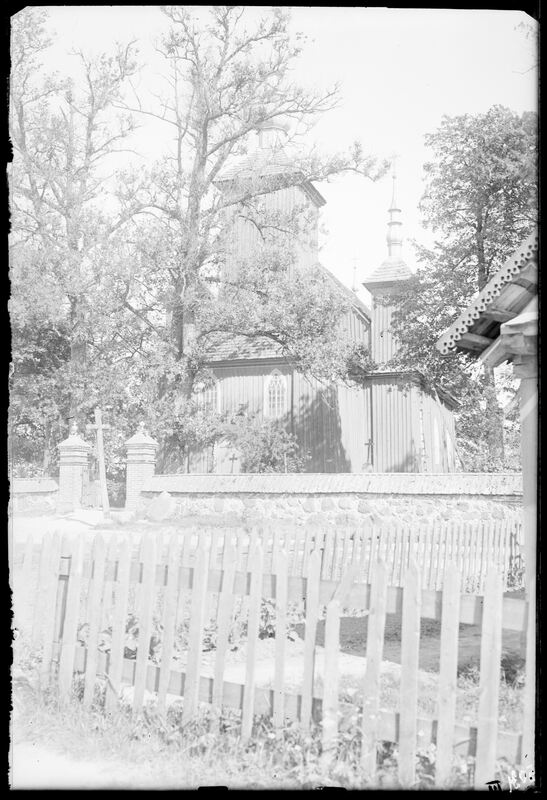
Negatyve įamžinta medinė Gasčiūnų Šv. Stanislovo Kostkos bažnyčia.