About the Church
The church of St Anthony of Padua at Pamūšis is a sacred building in the Romanesque Revival style, located in the village of Pamūšis, in the Diocese of Šiauliai, Pakruojis Deanery. This place is remarkable both for its architecture and for its rich history.
The first church on this site was built as early as 1621, when Sebastijonas Jaugelis endowed a masonry Reformed Church shrine. Over time, however, this church became the epicentre of conflicts between Reformed and Catholic believers. One of the most significant events took place on 18 July 1706, when Catholics from Klovainiai, returning in procession from Linkuva, ravaged the Reformed church and robbed the parish's faithful. This incident marked the beginning of the decline of the Reformed parish, and by 1763 the church was already abandoned.
Some time later, in 1905, this abandoned shrine was turned into a warehouse. Only after the First World War, once independence had been restored, was the church repaired and reconsecrated in 1924, through the efforts of parish priest Jurgis Stakauskas. Thanks to the support of Bishop Kazimieras Paltarokas, in 1935 the church was rebuilt to a design by the engineer Romanas Steikūnas.
The church has a cruciform plan, with turrets and semicircular arches. Its facade is adorned with windows of unequal height, which create a playful and rhythmic architectural composition. Inside are three Neo-Baroque altars and interesting features such as a stone altar table and an iron cross, donated by a German Catholic parish.
In the churchyard stands a wooden bell tower, rectangular in plan, timber-framed and clad vertically with boards. The bell tower narrows in volume towards the top, and its roof is a low, hipped roof with four slopes.
The history of the church of St Anthony of Padua at Pamūšis is full of challenges and renewals. From the conflict between the Reformed and the Catholics to its revival at the start of the 20th century, this church bears witness to the strength of faith and community. Despite difficult periods, it has remained an important place for local residents, enriching their spiritual life and preserving cultural heritage.
The first church on this site was built as early as 1621, when Sebastijonas Jaugelis endowed a masonry Reformed Church shrine. Over time, however, this church became the epicentre of conflicts between Reformed and Catholic believers. One of the most significant events took place on 18 July 1706, when Catholics from Klovainiai, returning in procession from Linkuva, ravaged the Reformed church and robbed the parish's faithful. This incident marked the beginning of the decline of the Reformed parish, and by 1763 the church was already abandoned.
Some time later, in 1905, this abandoned shrine was turned into a warehouse. Only after the First World War, once independence had been restored, was the church repaired and reconsecrated in 1924, through the efforts of parish priest Jurgis Stakauskas. Thanks to the support of Bishop Kazimieras Paltarokas, in 1935 the church was rebuilt to a design by the engineer Romanas Steikūnas.
The church has a cruciform plan, with turrets and semicircular arches. Its facade is adorned with windows of unequal height, which create a playful and rhythmic architectural composition. Inside are three Neo-Baroque altars and interesting features such as a stone altar table and an iron cross, donated by a German Catholic parish.
In the churchyard stands a wooden bell tower, rectangular in plan, timber-framed and clad vertically with boards. The bell tower narrows in volume towards the top, and its roof is a low, hipped roof with four slopes.
The history of the church of St Anthony of Padua at Pamūšis is full of challenges and renewals. From the conflict between the Reformed and the Catholics to its revival at the start of the 20th century, this church bears witness to the strength of faith and community. Despite difficult periods, it has remained an important place for local residents, enriching their spiritual life and preserving cultural heritage.
Gallery and Resources
Archive captions are shown in Lithuanian.
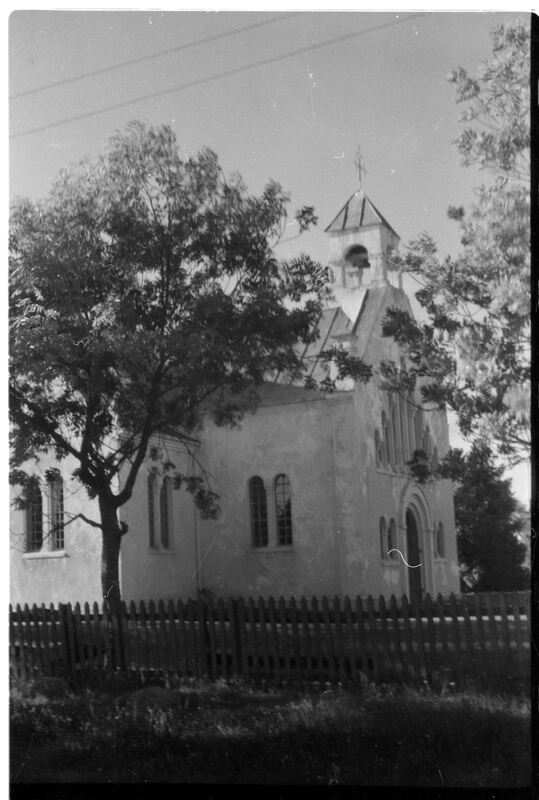
Pamūšio Šv. Antano Paduviečio bažnyčia.

Pamūšio Šv. Antano Paduviečio bažnyčia.