About the Church
The Church of All Saints in Pašušvys is one of the oldest and best-preserved masonry churches in Samogitia. This impressive church stands in the town of Pašušvys, surrounded by a charming landscape – the confluence of the Šušvė and its right tributary, the Žadikė.
The church combines architectural features of both the Renaissance and Classicism, treated in a folk manner, creating a uniquely charming aesthetic. It was built on a Latin-cross plan, with a three-sided apse and a small turret at the crossing of the nave and the transepts. This gives the church not only a majestic appearance but also a particular sense of space inside.
The history of the church in Pašušvys begins as early as the 16th century, when in 1553 the manor owner Šimkovičius-Vnučka built the first wooden church and set aside part of his estate for its upkeep. The church became the centre of the parish around 1566, but later, in 1589, it passed to the Reformed Evangelicals under the patronage of Sofija Vnučkienė. Only after long court disputes, which lasted until 1665, was the church returned to the Catholic community.
A major change came at the end of the 18th century, when the present masonry church was rebuilt between 1793 and 1798. The construction was initiated by the parish priest Dionizas Straševičius, who also established an almshouse and an altaria. The church's distinctive bell tower, built in 1795, has three tiers and adorns the whole church complex.
The church's interior is also worth attention. Here one can find a historic 10-stop organ, built in 1801 by the master builder Theodor Tiedemann the Elder. This organ, typical of the Hamburg school's construction, has a unique mechanical angel with a trumpet, whose arms can be moved by a stop at the console. Such a mechanical angel survives in only one other place in Lithuania – the church at Varlaukis.
The Church of All Saints in Pašušvys has been granted the feast of the Sacred Heart of Jesus, confirmed by Pope Clement XIII in 1767, and the feast of St Bartholomew, established in 1822 by Bishop Juozapas Arnulfas.
The churchyard, enclosed by a masonry wall with iron gates, adds further charm to this sacred site. A small shrine with a statue of Mary stands in it, its pedestal bearing the date 1914. The priest Matas Miežinis is also buried here; thanks to him, a four-language dictionary by his uncle Mykolas Miežinis was published in 1894.
The Church of All Saints in Pašušvys is undoubtedly a significant cultural monument, preserving a wealth of historical and artistic treasures, and bearing witness to the rich and complex heritage of Lithuania's religious history.
The church combines architectural features of both the Renaissance and Classicism, treated in a folk manner, creating a uniquely charming aesthetic. It was built on a Latin-cross plan, with a three-sided apse and a small turret at the crossing of the nave and the transepts. This gives the church not only a majestic appearance but also a particular sense of space inside.
The history of the church in Pašušvys begins as early as the 16th century, when in 1553 the manor owner Šimkovičius-Vnučka built the first wooden church and set aside part of his estate for its upkeep. The church became the centre of the parish around 1566, but later, in 1589, it passed to the Reformed Evangelicals under the patronage of Sofija Vnučkienė. Only after long court disputes, which lasted until 1665, was the church returned to the Catholic community.
A major change came at the end of the 18th century, when the present masonry church was rebuilt between 1793 and 1798. The construction was initiated by the parish priest Dionizas Straševičius, who also established an almshouse and an altaria. The church's distinctive bell tower, built in 1795, has three tiers and adorns the whole church complex.
The church's interior is also worth attention. Here one can find a historic 10-stop organ, built in 1801 by the master builder Theodor Tiedemann the Elder. This organ, typical of the Hamburg school's construction, has a unique mechanical angel with a trumpet, whose arms can be moved by a stop at the console. Such a mechanical angel survives in only one other place in Lithuania – the church at Varlaukis.
The Church of All Saints in Pašušvys has been granted the feast of the Sacred Heart of Jesus, confirmed by Pope Clement XIII in 1767, and the feast of St Bartholomew, established in 1822 by Bishop Juozapas Arnulfas.
The churchyard, enclosed by a masonry wall with iron gates, adds further charm to this sacred site. A small shrine with a statue of Mary stands in it, its pedestal bearing the date 1914. The priest Matas Miežinis is also buried here; thanks to him, a four-language dictionary by his uncle Mykolas Miežinis was published in 1894.
The Church of All Saints in Pašušvys is undoubtedly a significant cultural monument, preserving a wealth of historical and artistic treasures, and bearing witness to the rich and complex heritage of Lithuania's religious history.
Gallery and Resources
Archive captions are shown in Lithuanian.
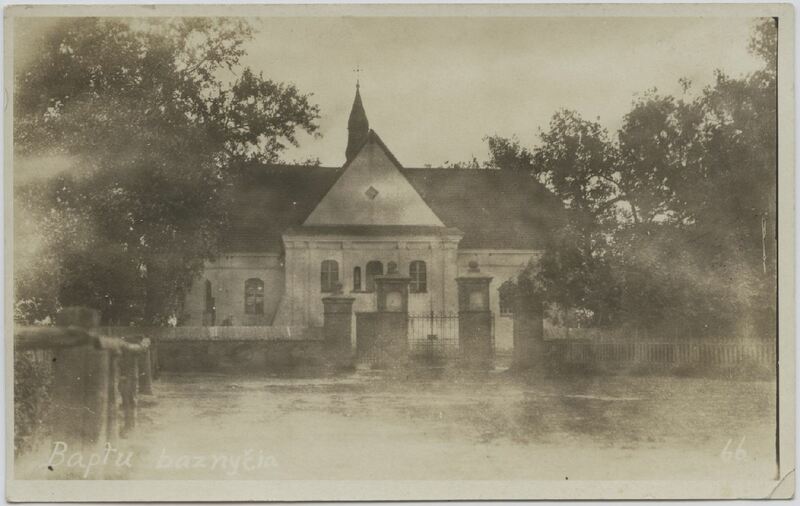
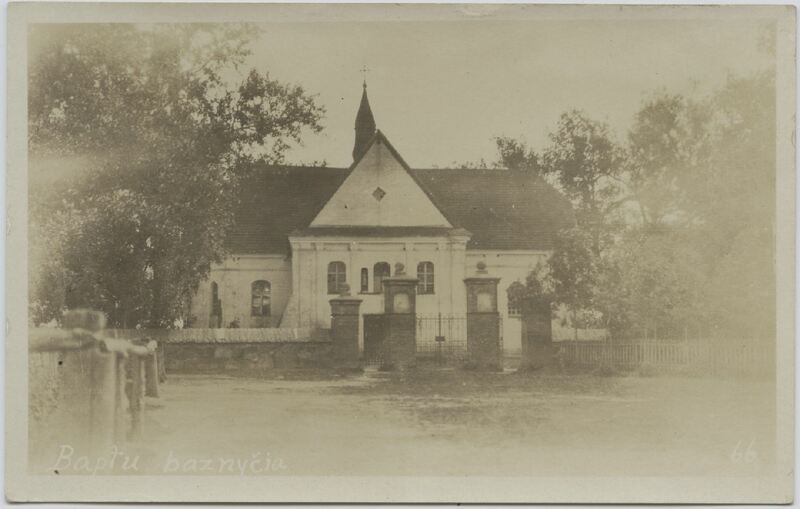
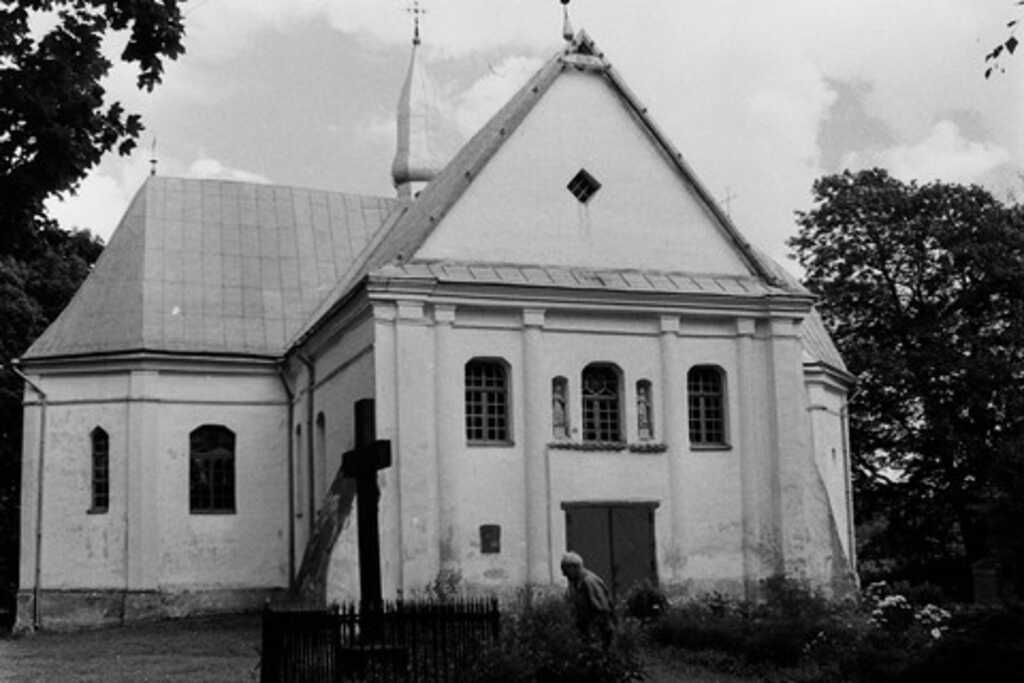
Pašušvio Visų Šventųjų bažnyčios fasadas.