About the Church
The Church of the Finding of the Holy Cross in Šeduva is a true gem of architecture and history, in the cosy town of Šeduva in Radviliškis district. This Renaissance church, with Baroque features, is striking not only for its distinctive style but also for its rich history, worth examining in detail.
The story of the church in Šeduva begins as early as the 16th century. The first wooden church here is believed to have been built in 1512, with the parish established soon after. As early as 1529 the church was granted three unused plots of land, and in 1542 the endowment was increased. That year a second wooden church was built and a parish school established.
A great turning point came in the mid-17th century, when Jeronimas Valavičius, Voivode of Upytė, commissioned a new masonry church between 1640 and 1649. This new church was consecrated in 1649 by Bishop Jurgis Tiškevičius. In the middle of the same decade, in 1647, the deanery of Šeduva was established, and in 1658 Mykolas Mačinskis founded an altaria and provided for its upkeep.
In the 18th century a Jesuit mission operated beside the church (1705–1769). During this period a bell tower also stood there, later demolished. The church suffered fires twice: after the fire of 1799 it was rebuilt in 1804 by the manor owner Stanislovas Poniatovskis. But in 1829 a fire caused by lightning again damaged the church's tower.
The 20th century was not easy either. After the uprising of 1863 the Russian administration confiscated half of the parish's lands, and in 1864 ordered the demolition of a cross that stood in the town square; an Orthodox church was built in its place in 1877, which was itself demolished only in 1935.
The church was an important cultural centre, especially in the late 19th century, when the priests Stasys Janeliūnas, Pranas Janulaitis and Kazys Marcinkevičius distributed banned press. In the early 20th century, on the initiative of the parish priest Povilas Šalučka, the church was extended by adding two side naves.
The last major changes came in the mid- and late 20th century, when the church was damaged during the Second World War but was later renovated, on the initiative of the dean Mykolas Karosas in 1937 and through the efforts of canon Bronius Antanaitis in 1974.
Architecturally the church in Šeduva has a cross-shaped plan with a semicircular apse, low sacristies and two towers. Inside it reveals a three-nave structure with five altars and barrel vaults. The church is surrounded by a wall of stone masonry, where such distinguished figures as the parish priest, prelate Mykolas Karosas, and the priest Augustinas Pranskėtis are laid to rest.
Today the Church of the Finding of the Holy Cross in Šeduva is not only a house of prayer but also a living witness to Lithuanian history, connected with numerous significant events and figures. Its walls speak of an honourable past and remind us of a heritage worth knowing and preserving.
The story of the church in Šeduva begins as early as the 16th century. The first wooden church here is believed to have been built in 1512, with the parish established soon after. As early as 1529 the church was granted three unused plots of land, and in 1542 the endowment was increased. That year a second wooden church was built and a parish school established.
A great turning point came in the mid-17th century, when Jeronimas Valavičius, Voivode of Upytė, commissioned a new masonry church between 1640 and 1649. This new church was consecrated in 1649 by Bishop Jurgis Tiškevičius. In the middle of the same decade, in 1647, the deanery of Šeduva was established, and in 1658 Mykolas Mačinskis founded an altaria and provided for its upkeep.
In the 18th century a Jesuit mission operated beside the church (1705–1769). During this period a bell tower also stood there, later demolished. The church suffered fires twice: after the fire of 1799 it was rebuilt in 1804 by the manor owner Stanislovas Poniatovskis. But in 1829 a fire caused by lightning again damaged the church's tower.
The 20th century was not easy either. After the uprising of 1863 the Russian administration confiscated half of the parish's lands, and in 1864 ordered the demolition of a cross that stood in the town square; an Orthodox church was built in its place in 1877, which was itself demolished only in 1935.
The church was an important cultural centre, especially in the late 19th century, when the priests Stasys Janeliūnas, Pranas Janulaitis and Kazys Marcinkevičius distributed banned press. In the early 20th century, on the initiative of the parish priest Povilas Šalučka, the church was extended by adding two side naves.
The last major changes came in the mid- and late 20th century, when the church was damaged during the Second World War but was later renovated, on the initiative of the dean Mykolas Karosas in 1937 and through the efforts of canon Bronius Antanaitis in 1974.
Architecturally the church in Šeduva has a cross-shaped plan with a semicircular apse, low sacristies and two towers. Inside it reveals a three-nave structure with five altars and barrel vaults. The church is surrounded by a wall of stone masonry, where such distinguished figures as the parish priest, prelate Mykolas Karosas, and the priest Augustinas Pranskėtis are laid to rest.
Today the Church of the Finding of the Holy Cross in Šeduva is not only a house of prayer but also a living witness to Lithuanian history, connected with numerous significant events and figures. Its walls speak of an honourable past and remind us of a heritage worth knowing and preserving.
Gallery and Resources
Archive captions are shown in Lithuanian.
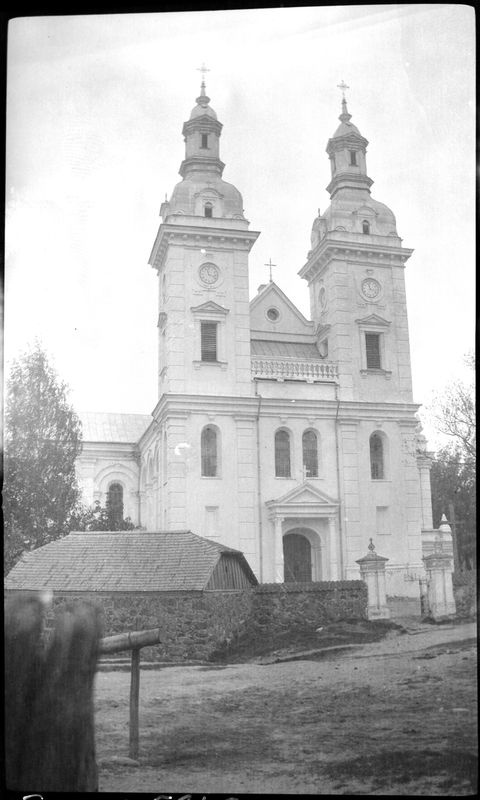
Rozalimo Švč. Mergelės Marijos Vardo bažnyčia.
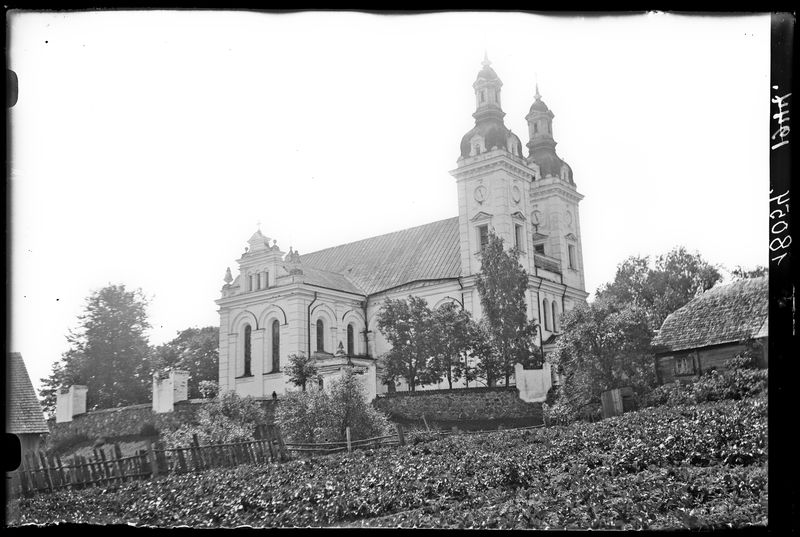
Stiklo negatyve užfiksuota mūrinė bažnyčia trijų ketvirčių rakursu. Sakralinis pastatas renesansinių ir barokinių architektūros formų, su dviem bokštais ir puošniu transeptu. Bažnyčios stogas dvišlaitis, bokštų stogai keturšlaičiai, su kupolais. Šventoriaus tvora akmenų mūro, su masyviais stačiakampiais stulpais, dengta dvišlaičiu stogu.
Šeduvos šv. Kryžiaus atradimo bažnyčia.