About the Church
The church's origins go back to the 18th century, when Prelate Vjušinskas of the chapter of the Diocese of Samogitia built the first chapel around 1753–1763. It was a modest but important place of worship for the local people, cared for by the Kartena presbytery. Later, in 1903, the present church was built by Fr Povilas Svilas together with the faithful, for whom it became a sacred and cherished place.
The church is an example of wooden architecture typical of the Historicist period, strongly influenced by Gothic Revival forms and secular resort architecture. Its rectangular plan, square turret and five-sided apse lend the whole building particular grace and harmony. Inside, visitors are greeted by three altars, whose decorative elements testify to the skill of past craftsmen.
It is worth noting that Fr Felicijonas Lelis served at the church and actively contributed to the cultivation of Lithuanian culture. On his initiative, illegal schools operated in the surrounding area, promoting children's education in their native language, and in 1908 a branch of the St Casimir Society was founded here.
The parish established in Budriai in 1926 further strengthened the ties within the local community. A choir and a Pavasaris youth group formed around the church, and from 1934 to 1939 the parish was served by Fr K. Andriekus, who had returned from Russia. Since then the parish has belonged to the Palanga Deanery of the Diocese of Telšiai.
In 2005 the Church of the Exaltation of the Holy Cross in Budriai, its bell tower and the churchyard fence with its gates were declared a state-protected complex of immovable cultural heritage. This reflects the importance of the site not only for the religious community but also for Lithuania's cultural heritage.
Next to the church stands a wooden bell tower, almost square in plan, of two tiers, which blends subtly with the main building. The whole churchyard is enclosed by a low stone-masonry wall, decorated on the south-western side with a Gothic Revival gate with an ornate wrought-iron wicket gate. It is also worth mentioning that the grounds contain a wayside shrine and the graves of priests, which recall the church's long history and its spiritual leaders.
The Church of the Exaltation of the Holy Cross in Budriai is a place where religious reverence, historical heritage and cultural memory converge, where every corner breathes the grandeur of the past and the devotion of the local people.
Gallery and Resources
Archive captions are shown in Lithuanian.

Keturių kadrų nespalvotos perforuotos fotojuostos „Svema“ ketvirtasis kadras. Nufotografuota Budrių bažnyčia ir varpinė, Žalgirio apyl., Kretingos r. Bendras vaizdas iš pietvakarių pusės. Fotografavo Julius Kanarskas, Kretingos rajoninių kultūros rūmų vyr. metodininkas paminklų apsaugai, 1989 m.
Bažnyčia medinė, istorizmo laikotarpio, neogotikos ir pasaulietinės kurortų architektūros, pastatyta 1903 m. kunigo Povilo Svilo ir parapijiečių rūpesčiu, konsekruota Šv. Kryžiaus Išaukštinimo titulu. Varpinė karkasinės konstrukcijos, lentinė, stačiakampė stačiasienė, dviejų tarpsnių, pastatyta 1906 m. Vartai raudonų plytų mūro, tinkuoti, neogotikiniai, statyti apie 1906–1909 m.
Valstybės saugomas kultūros vertybių kompleksas (unikalus komplekso kodas 30572; senasis vertybių registro kodas G525K), turintis architektūrinį, sakralinį ir kraštovaizdžio vertingųjų savybių pobūdį.
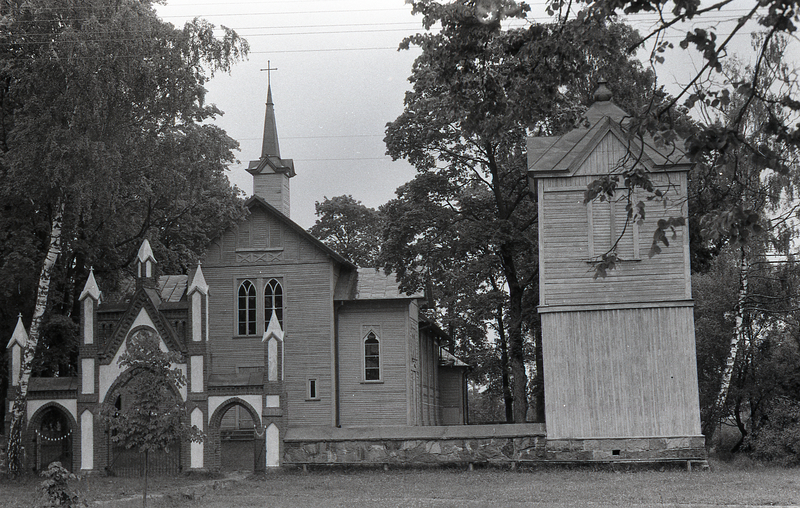
Keturių kadrų nespalvotos perforuotos fotojuostos „Svema“ trečiasis kadras. Nufotografuota Budrių bažnyčia ir varpinė, Žalgirio apyl., Kretingos r. Bendras vaizdas iš pietvakarių pusės. Fotografavo Julius Kanarskas, Kretingos rajoninių kultūros rūmų vyr. metodininkas paminklų apsaugai, 1989 m.
Bažnyčia medinė, istorizmo laikotarpio, neogotikos ir pasaulietinės kurortų architektūros, pastatyta 1903 m. kunigo Povilo Svilo ir parapijiečių rūpesčiu, konsekruota Šv. Kryžiaus Išaukštinimo titulu. Varpinė karkasinės konstrukcijos, lentinė, stačiakampė stačiasienė, dviejų tarpsnių, pastatyta 1906 m. Vartai raudonų plytų mūro, tinkuoti, neogotikiniai, statyti apie 1906–1909 m.
Valstybės saugomas kultūros vertybių kompleksas (unikalus komplekso kodas 30572; senasis vertybių registro kodas G525K), turintis architektūrinį, sakralinį ir kraštovaizdžio vertingųjų savybių pobūdį.