About the Church
The church's history began in the 18th century, when in 1789 (or 1778, according to Bishop Motiejus Valančius) Jokūbas Ignotas Nagurskis, founder of the Jokūbavas manor, built a small wooden church. It was dedicated to St Cajetan and became a branch of the Kretinga parish church. Although Mass was celebrated there, other sacraments were not administered. In 1793 a wooden almshouse sprang up beside the church, and a cemetery was established nearby.
At the beginning of the 19th century Canon Stanislovas Čerskis noted that the small church and the priest's house had become very dilapidated and required repair. However, a lack of funds prevented the necessary renovations. Therefore, in 1864, at the request of Feliksas Rimkevičius, parish priest of Kretinga, the Jokūbavas landowner Konstantinas Parčevskis built a new masonry church, dedicated under the title of the Blessed Virgin Mary.
At the beginning of the 20th century several religious and social organisations operated around the church, such as the Third Order congregation, the Catholic youth union "Pavasaris", the Temperance Society and the children's Guardian Angel society. These organisations promoted religious, cultural and educational activities within the community.
Unfortunately, at the end of the Second World War, in 1945, the church burned down. Its rebuilding began only during the Reform Movement (Atgimimas) period. The architect Edmundas Giedrimas drew up the design for the new church, and in 1991–1996 a new church was built on foundations blessed by Bishop Antanas Vaičius of Telšiai. It is a plastered-masonry, single-tower, single-aisled structure.
The churchyard was also renovated: it is enclosed by a plastered-masonry wall, and openwork metal gates were installed in front of the church. In 1991 a cross was erected by the church to commemorate a visit by the Bishop of Telšiai, and at the other end of the path a cross honouring partisans who died in 1948. Behind the church there also stand a wayside shrine and two crosses.
The Church of the Blessed Virgin Mary in Jokūbavas is not merely a place of prayer – it is also an important part of the historical and cultural heritage, linking past and present and recalling the community's resilience and faith through the ages.
Gallery and Resources
Archive captions are shown in Lithuanian.
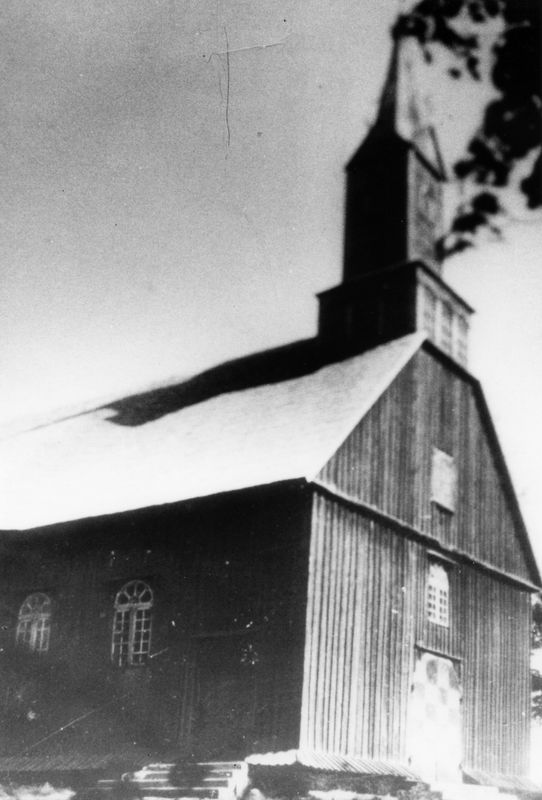
Jokūbavo Švč. Mergelės Marijos bažnyčios vaizdas iš pietų pusės. Pastatyta 1864 m. Kretingos parapijos klebono ir bernardinų vienuolyno gvardijono tėvo Felikso Rimkevičiaus OFM iniciatyva bei Jokūbavo dvarininko Konstantino Parčevskio (1843–1902) lėšomis vietoje sunykusios senosios Šv. Kajetono bažnyčios. Konsekruota Šv. Mergelės Marijos titulu. Ji medinė, vienabokštė, stačiakampio plano. Sudegė 1944 m., per Antrąjį pasaulinį karą.
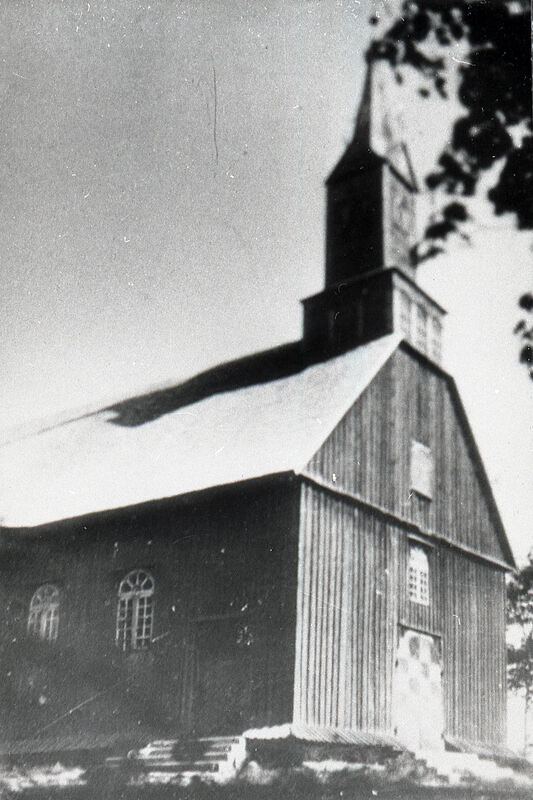
Jokūbavo Švč. Mergelės Marijos bažnyčios vaizdas iš pietų pusės. Pastatyta 1864 m. Kretingos parapijos klebono ir bernardinų vienuolyno gvardijono tėvo Felikso Rimkevičiaus OFM iniciatyva bei Jokūbavo dvarininko Konstantino Parčevskio (1843–1902) lėšomis vietoje sunykusios senosios Šv. Kajetono bažnyčios. Konsekruota Šv. Mergelės Marijos titulu. Ji medinė, vienabokštė, stačiakampio plano. Bažnyčia sudegė 1944 m., per Antrąjį pasaulinį karą.