About the Church
The church's history begins back in the 16th century, when in 1540 Queen Bona ordered local peasants to support the Palanga church. Soon afterwards, in 1579, the first parish priest of Palanga was already mentioned. Over the centuries the church underwent many changes – it was rebuilt and reconstructed several times. Until 1597 a church stood in Palanga, built on the site of a church taken from the Protestants.
In 1767 a wooden church was built here, which served the parish for more than a century. However, the present masonry church we see today was built in 1898–1907 to a design by the architect Karlas Eduardas Strandmanas. Funding for the construction was provided by Count Tiškevičius and local parishioners, led by parish priest Juozapas Šniukšta.
This Gothic Revival church, with its cruciform plan and single tower, still impresses visitors today with its grandeur and architectural solutions. Its interior is no less impressive: the central altar, the organ and the splendid stained-glass windows create a special atmosphere.
One of the more interesting facts about the church is that in 2018 an observation platform was opened in its tower, at a height of 21 metres. From this platform a magnificent panorama opens out over the whole of Palanga and the Baltic Sea, which attracts many tourists.
Several notable people are also buried in the churchyard, among them the parish priest of Palanga, Monsignor Bronius Barauskas, and Fr Kazimieras Prapuolenis. The work and contribution of these people to the life of the parish are significant and deserve to be remembered.
It is also worth mentioning that a chapel is believed to have stood on Birutė Hill as early as the 16th century. Even in the mid-19th century, despite the prohibitions of the Russian authorities, local people managed to preserve this shrine, which still stands today.
These are just a few of the fascinating details about the Church of the Assumption of the Blessed Virgin Mary in Palanga. Everyone who visits this church can sense not only its religious but also its historical importance, learn about the rich history of the Palanga parish, and enjoy its architectural masterpieces.
Gallery and Resources
Archive captions are shown in Lithuanian.

Nespalvotas, vertikalaus formato atvirukas, spausdintas rudos spalvos poligrafiniais dažais iš fotografijos. Palangos Švč. Mergelės Marijos Ėmimo į dangų bažnyčia. Bendras vaizdas iš šiaurės vakarų pusės. Nežinomas leidėjas. XX a. I ketv.
Matosi nuo Vytauto ir Kretingos gatvių pusės nufotografuotos Palangos katalikų parapijos bažnyčios nugarinis ir šoninis fasadai. Ji neogotikinė, vienbokštė, degto molio plytų mūro, su transeptu ir daugiakampe apside. Šventorių juosia to paties stiliaus tvora, mūryta iš degto molio plytų. Priešais šventorių – akmenimis grįsta Vytauto gatvė, kurioje stoviniuoja ir vaikšto žmonės. Dešinėje pusėje kyšo dviaukščio, tinkuoto mūro Palangos progimnazijos pastato kampas. Viršuje, dešinėje pusėje išspausdinta antraštė: „Palanga / Kataliku bažnyčia.“
Reversas tipinis, horizontalaus formato, skersinės ištisinės linijos padalintas į įrašo (siauresnis) ir adreso laukus. Adreso vietą žymi 4 punktyrinės išilginės linijos. Priešais apatinę liniją išspausdintas numeris: „U 93“.
Neogotikinė Palangos Švč. Mergelės Marijos Ėmimo bažnyčia pastatyta 1898–1907 m. vietoje senos medinės. Ją projektavo architektas Karlas Eduardas Strandmanas, statė – parapijiečiai. Trečdalį statybos išlaidų sumokėjo grafai Feliksas ir Antanina Sofija Tiškevičiai, likusias – klebono Juozapo Šniukštos vadovaujami parapijiečiai.
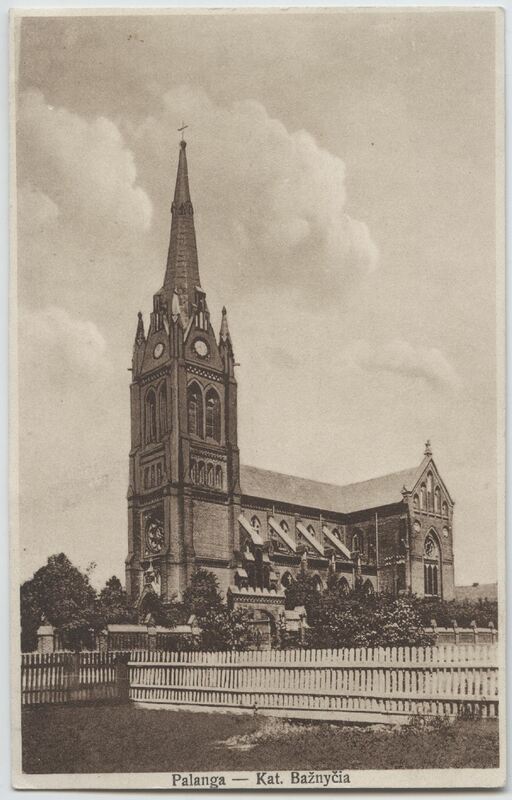
[Palangos Švč. Mergelės Marijos Emimo į dangų bažnyčia]
Meno Fotografija J. Stropus. Apie 1929.
Spaustuvės numeracija pašto ženklo rėmelio vietoje: W 500 29.