About the Church
The Church of St Anne in Jašiūnai is a remarkable shrine, rich in historical and cultural heritage. Situated in the small town of Jašiūnai, near Vilnius, the church is an important religious and social centre for the local community.
The church's history begins as early as 1515, when land with four peasant households was assigned to the Jašiūnai altar benefice. For many years this land belonged to various religious denominations: in the second half of the 16th century it was held by the Reformed Evangelicals, and in 1640 the Catholic church was plundered by troops under Jonušas Radvila. Later, in the early 18th century, the Swedish army burned the shrine down.
Through the twists of history the Jašiūnai church lived through more than one difficult moment. In 1830 a chapel was set up here, which was later closed in 1866. For a long time a Dominican friar lived in Jašiūnai, supported by the owners of the local manor.
In the early 20th century, on 7 March 1926 to be precise, a significant general assembly was held, at which it was decided to build a new shrine. The building materials and the plot of land were donated by Aleksander and Anna Pereświt-Sołtan. The architect Henryk Ganello drew up the design for the wooden church, which featured characteristics typical of Polish vernacular architecture.
The cornerstone of the new shrine was blessed on 16 October 1927, and a year later the church was solemnly opened. In 1930 a parish was established, headed by the priest Józef Staszkiewicz. It is worth noting that in 1935, with funds raised by parishioners, a copy of the image of the Blessed Virgin Mary of Aušros Vartai was purchased and solemnly brought into the church on 8 September.
Despite historical unrest and conflicts over language use between the local Lithuanians and Poles, the church remained an important part of the local community. Even during the Second World War, when the parish priest Piotr Wojno-Orański was arrested and imprisoned, the church did not lose its significance. After the war, through the efforts of the parish priest and the parishioners, the church was renovated in 1965.
In 1999 a timber-frame bell tower with two bells was built on the church square, enriching the shrine's architectural ensemble. The church is a unique work of architecture, its lower part built of masonry and its upper part of wood, the whole structure adorned with one tower and a small turret.
Inside, the church has three aisles separated by piers, and five altars adorning the interior. It is a place where history, spiritual life and community traditions meet, preserving a rich past while looking to the future.
The church's history begins as early as 1515, when land with four peasant households was assigned to the Jašiūnai altar benefice. For many years this land belonged to various religious denominations: in the second half of the 16th century it was held by the Reformed Evangelicals, and in 1640 the Catholic church was plundered by troops under Jonušas Radvila. Later, in the early 18th century, the Swedish army burned the shrine down.
Through the twists of history the Jašiūnai church lived through more than one difficult moment. In 1830 a chapel was set up here, which was later closed in 1866. For a long time a Dominican friar lived in Jašiūnai, supported by the owners of the local manor.
In the early 20th century, on 7 March 1926 to be precise, a significant general assembly was held, at which it was decided to build a new shrine. The building materials and the plot of land were donated by Aleksander and Anna Pereświt-Sołtan. The architect Henryk Ganello drew up the design for the wooden church, which featured characteristics typical of Polish vernacular architecture.
The cornerstone of the new shrine was blessed on 16 October 1927, and a year later the church was solemnly opened. In 1930 a parish was established, headed by the priest Józef Staszkiewicz. It is worth noting that in 1935, with funds raised by parishioners, a copy of the image of the Blessed Virgin Mary of Aušros Vartai was purchased and solemnly brought into the church on 8 September.
Despite historical unrest and conflicts over language use between the local Lithuanians and Poles, the church remained an important part of the local community. Even during the Second World War, when the parish priest Piotr Wojno-Orański was arrested and imprisoned, the church did not lose its significance. After the war, through the efforts of the parish priest and the parishioners, the church was renovated in 1965.
In 1999 a timber-frame bell tower with two bells was built on the church square, enriching the shrine's architectural ensemble. The church is a unique work of architecture, its lower part built of masonry and its upper part of wood, the whole structure adorned with one tower and a small turret.
Inside, the church has three aisles separated by piers, and five altars adorning the interior. It is a place where history, spiritual life and community traditions meet, preserving a rich past while looking to the future.
Gallery and Resources
Archive captions are shown in Lithuanian.
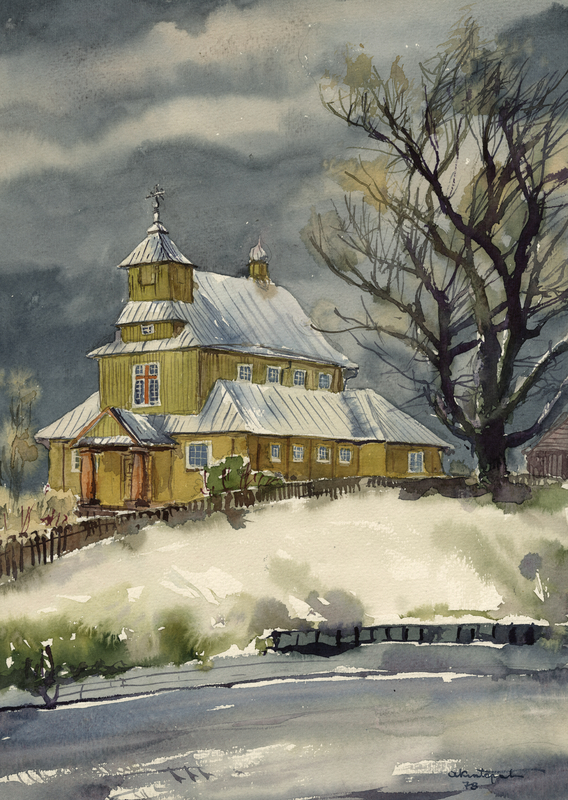
Jašiūnų Šv. Onos bažnyčia.
Signuotas akvarele averso apatinėje dalyje dešinėje, pieštuku revrese.
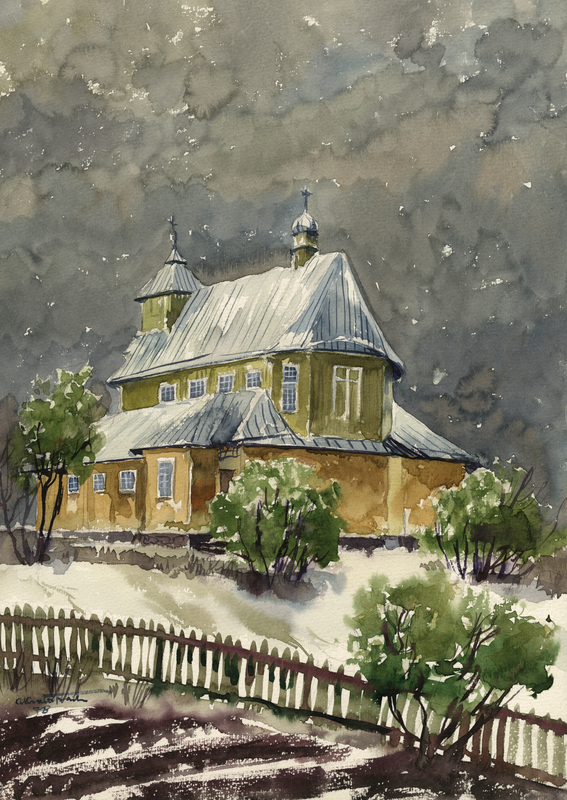
Jašiūnų Šv. Onos bažnyčia.
Signuotas akvarele averso apatinėje dalyje kairėje autoriaus parašu ir data: „78“, pieštuku revrese: „.JAŠIŪNAI / 1978. X. 22“.