About the Church
The history of this church began in 1469, when the Grand Duke of Lithuania Casimir IV Jagiellon founded a Bernardine monastery and a wooden church on the site of a former pagan temple. It was thus the seventh church in Vilnius at that time. Unfortunately, the first wooden church burned down in a fire in 1475, and a new masonry church soon began to be built on its site. However, this one too suffered setbacks because of poor building materials and flooding.
By 1512 the church had been remodelled: a porch was built in masonry, the vaults were re-laid, the walls decorated, and it was consecrated in 1520. The church was renovated and decorated further, up to 1525. At the start of the 16th century the Bernardine church was given the name of the “Third Construction” in the Bernardine chronicles.
The church's architectural design clearly shows Gothic features – red brick masonry, pointed-arch windows, and crystal and net vaults. On the upper part of the main façade is a fresco depicting the Crucified Christ, which lends the building a particular sacred character. Interestingly, there are loopholes in the church's walls – a reminder of its integration into the city's defensive system.
Over its long existence the church suffered more than once from wars and fires. After the fire of 1564, which destroyed part of the church's vaults, repair work was carried out and the church rose again from the ashes. Even harder times dawned for the church in 1655, when the Russian army killed many of the monks who had hidden in the church and ravaged the buildings. Later, with funding from the Voivode of Vilnius, Mikalojus Pacas, the church was rebuilt and enriched with Baroque elements.
In the 19th and 20th centuries the church underwent considerable change and was even closed under Soviet rule. Fortunately, in 1994 the Order of Friars Minor returned to the church and began to revive it.
The interior of the Bernardine Church also astonishes with its beauty and historical elements. Here late Gothic vaults survive, along with authentic frescoes depicting 16th-century biblical scenes, and a wealth of altars with striking works of art. One of the most notable objects is the tombstone of the Marshal of the Grand Duchy of Lithuania Stanislovas Radvila, which testifies to the church's importance to the nobility of Lithuania.
St Francis of Assisi's Church in Vilnius is not only a place of religious observance but also a unique cultural treasure, symbolising the history, art and architecture of Vilnius. It is a true historical treasure well worth visiting and getting to know.
Gallery and Resources
Archive captions are shown in Lithuanian.
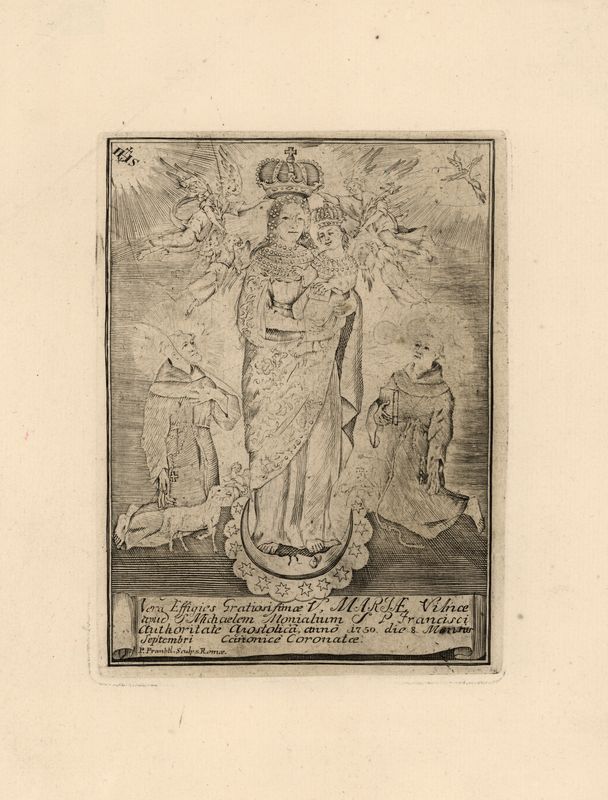
Detalaus piešinio, kruopščiu štrichu išraižytas Švč. Mergelės Marijos atvaizdas, sukurtas pagal stebuklingu laikomą paveikslą, buvusį Šv. Mykolo bažnyčioje Vilniuje. Šis nežinomo dailininko nutapytas paveikslas nuo XVI a. buvo laikomas Vilniaus Šv. Pranciškaus Asyžiečio ir šv. Bernardino (Bernardinų) bažnyčioje, ir ten pradėjo garsėti prie jo patiriamomis malonėmis. 1596 paveikslas buvo perkeltas į Šv. Mykolo bažnyčią, funduotą Leono Sapiegos. Graviūros kompozicija labai artima garsiajam paveikslui: skriejančių angelų karūnuota Švč. Mergelė Marija laiko Kūdikėlį Jėzų, prie jos kojų klūpi šv. Pranciškus ir šv. Bernardinas. Vaizdas apjuostas siauru stačiakampiu rėmu, kurio apačioje, juostoje, įkomponuotas tekstas. Raižinys atspaustas nuo pažeistos, nežymiai subraižytos klišės.
Aprašė Regina Urbonienė
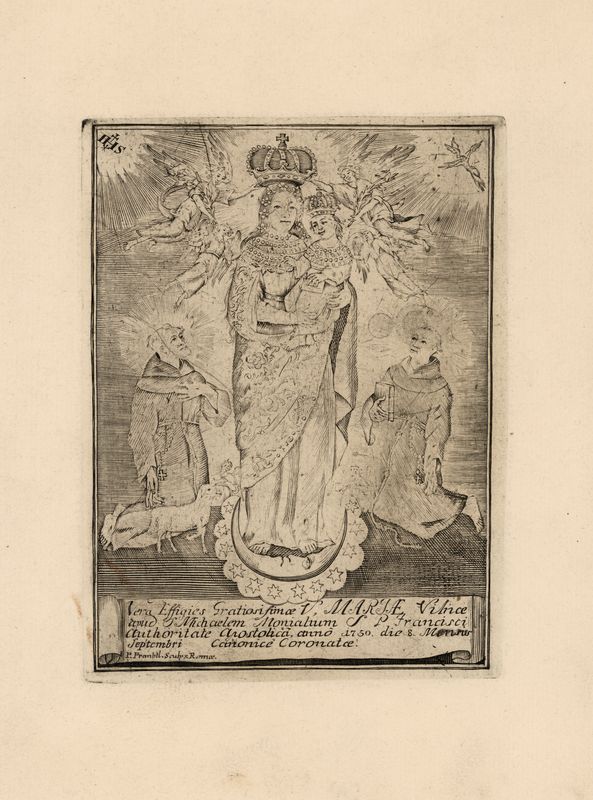
Detalaus piešinio, kruopščiu štrichu išraižytas Švč. Mergelės Marijos atvaizdas, sukurtas pagal stebuklingu laikomą paveikslą, buvusį Šv. Mykolo bažnyčioje Vilniuje. Šis nežinomo dailininko nutapytas paveikslas nuo XVI a. buvo laikomas Vilniaus Šv. Pranciškaus Asyžiečio ir šv. Bernardino (Bernardinų) bažnyčioje, ir ten pradėjo garsėti prie jo patiriamomis malonėmis. 1596 paveikslas buvo perkeltas į Šv. Mykolo bažnyčią, funduotą Leono Sapiegos. Graviūros kompozicija labai artima garsiajam paveikslui: skriejančių angelų karūnuota Švč. Mergelė Marija laiko Kūdikėlį Jėzų, prie jos kojų klūpi šv. Pranciškus ir šv. Bernardinas. Vaizdas apjuostas siauru stačiakampiu rėmu, kurio apačioje, juostoje, įkomponuotas tekstas. Raižinys atspaustas nuo pažeistos, nežymiai subraižytos klišės.
Aprašė Regina Urbonienė