About the Church
Situated in Užupis, in the Old Town of Vilnius, St Bartholomew the Apostle's Church has a long and colourful history, full of rises and falls, reflected not only in its architecture but also in the life of its community.
The first wooden church on this site was built as early as the beginning of the 17th century, but it burned down during the war with Moscow around 1665. More than a century later, in 1778, a monastic oratory was built here to a design by the talented architect Martin Knackfus. Unfortunately this building did not last long — the 1794 uprising damaged it severely.
Fortunately, in the early 19th century this place was revived by Father Augustinas Stodolnikas. Thanks to him, a masonry church was built here in 1823–1824, and it has adorned the Vilnius skyline ever since. The church was consecrated on 24 August 1823 and given the name of St Bartholomew the Apostle. Modest and unplastered, yet full of spirituality, the church became an important hub of the local community.
Although the church was initially simple and lacking in ornament, over time it was changed by ever new works and restorations. The bell tower, rebuilt in 1834, gave it greater expressiveness. Later the church was plastered, and in 1879–1881 it was enriched by repair works funded by the Vilnius potters' and ceramics guild, and by the addition of a tower in the Historicist style.
St Bartholomew's Church has always been more than just a religious building. It housed the image of the Virgin Mary of the Trakai Gate and the archive of the potters' and ceramics guild. The church had three, and later five, altars, and the choir loft was supported by two columns. In the past the walls of this church were reinforced with a stone embankment and a wall, to protect it from the damaging effects of the Vilnia river.
In the first half of the 20th century the church became a filial church of the Holy Trinity Church in Sudervė. It is also worth mentioning that the famous painter Ferdynand Ruszczyc was married here and stipulated in his will that his heart be buried in this very church.
During the Soviet era this church went through hard times. In 1948 it was closed and its premises turned into sculptors' workshops. The choir loft and sacristy became studios, and a boiler room was installed in the church itself. Although many valuable items belonging to the church were lost, the organ miraculously survived.
In 1997 the Vilnius Belarusian Catholic community, having regained the church, revived it, and services are now held there in Belarusian. The church is cared for by the friars of the Capuchin Custody of Belarus. Although time and human hands have left their mark, St Bartholomew the Apostle's Church remains not only an architectural monument but also a living community centre, where people find peace and an atmosphere that awakens the spirit.
The first wooden church on this site was built as early as the beginning of the 17th century, but it burned down during the war with Moscow around 1665. More than a century later, in 1778, a monastic oratory was built here to a design by the talented architect Martin Knackfus. Unfortunately this building did not last long — the 1794 uprising damaged it severely.
Fortunately, in the early 19th century this place was revived by Father Augustinas Stodolnikas. Thanks to him, a masonry church was built here in 1823–1824, and it has adorned the Vilnius skyline ever since. The church was consecrated on 24 August 1823 and given the name of St Bartholomew the Apostle. Modest and unplastered, yet full of spirituality, the church became an important hub of the local community.
Although the church was initially simple and lacking in ornament, over time it was changed by ever new works and restorations. The bell tower, rebuilt in 1834, gave it greater expressiveness. Later the church was plastered, and in 1879–1881 it was enriched by repair works funded by the Vilnius potters' and ceramics guild, and by the addition of a tower in the Historicist style.
St Bartholomew's Church has always been more than just a religious building. It housed the image of the Virgin Mary of the Trakai Gate and the archive of the potters' and ceramics guild. The church had three, and later five, altars, and the choir loft was supported by two columns. In the past the walls of this church were reinforced with a stone embankment and a wall, to protect it from the damaging effects of the Vilnia river.
In the first half of the 20th century the church became a filial church of the Holy Trinity Church in Sudervė. It is also worth mentioning that the famous painter Ferdynand Ruszczyc was married here and stipulated in his will that his heart be buried in this very church.
During the Soviet era this church went through hard times. In 1948 it was closed and its premises turned into sculptors' workshops. The choir loft and sacristy became studios, and a boiler room was installed in the church itself. Although many valuable items belonging to the church were lost, the organ miraculously survived.
In 1997 the Vilnius Belarusian Catholic community, having regained the church, revived it, and services are now held there in Belarusian. The church is cared for by the friars of the Capuchin Custody of Belarus. Although time and human hands have left their mark, St Bartholomew the Apostle's Church remains not only an architectural monument but also a living community centre, where people find peace and an atmosphere that awakens the spirit.
Gallery and Resources
Archive captions are shown in Lithuanian.
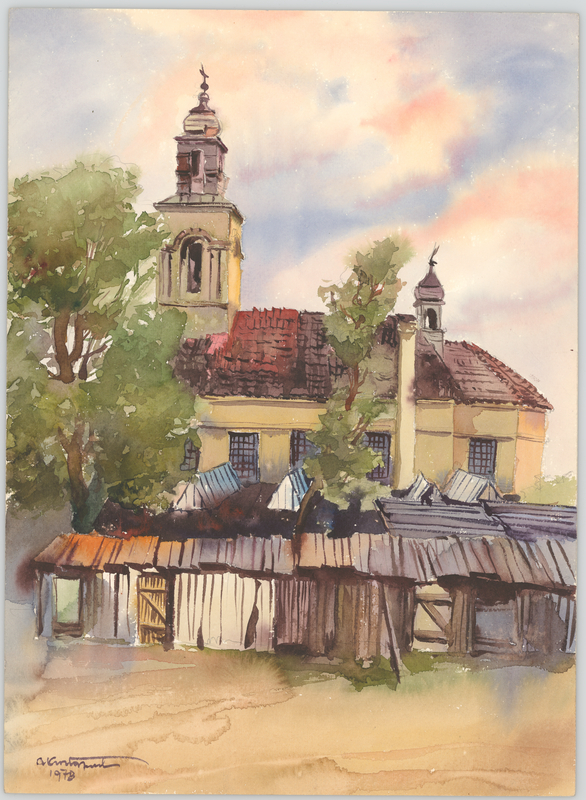
Kompozicijoje – Vilniaus Šv. apaštalo Baltramiejaus bažnyčia.
Signuotas akvarele averso apatinėje dalyje kairėje ir pieštuku reverso viršutinėje dalyje kairėje.