About the Church
This church has repeatedly changed its appearance and function. After the fires of 1748 and 1749 it was rebuilt: a new chancel and two towers were built in masonry, and a new portal appeared in place of the Gothic apse. In the 19th century the tsarist Russian authorities converted the church into an Orthodox church, but after the First World War, in 1920, it once again became Catholic.
During the Soviet period the church went through hard times: it was abandoned, and part of its facade even collapsed in 1968. But this did not halt the restoration work — in 1971 the three-sided Gothic apse was restored. The surviving building next to the church also has a long and varied history: it housed a men's almshouse, a presbytery, the Vilnius Lithuanian Club and the Vilnius Lithuanian Students' Union.
In 2004 the church was adapted for the veneration of the famous painting Divine Mercy. This painting, painted by Eugeniusz Kazimirowski in 1934 according to the vision of St Faustina, is one of the most prominent sites of Catholic pilgrimage in Vilnius. Mass is celebrated in the church in both Lithuanian and Polish, reflecting its cross-cultural significance.
It is more than simply a religious building — it is a place where the layers of Vilnius's history, religion and culture intertwine. A visit to this church allows one to sense the breath of history and immerse oneself in a world of faith that has, for several centuries, united people from different eras.
Gallery and Resources
Archive captions are shown in Lithuanian.
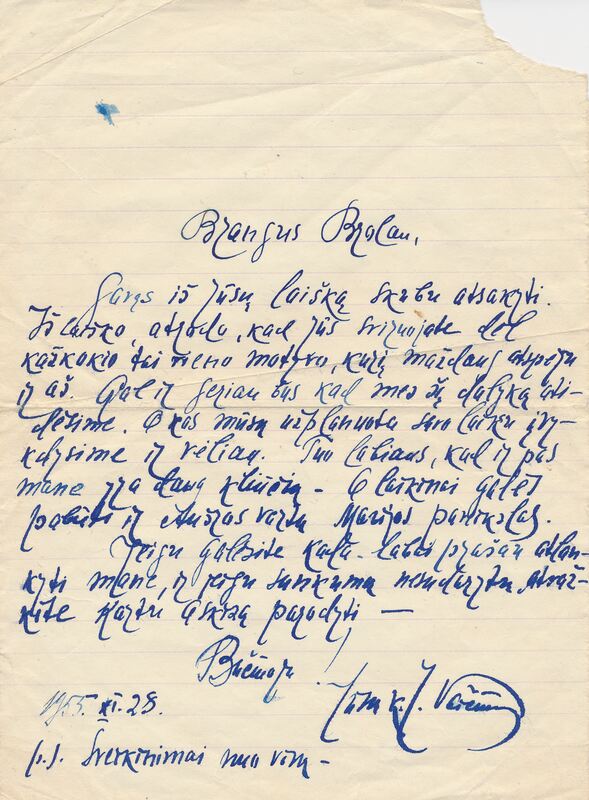
Laiškas. Rankraštis. Kunigo Juozo Vaičiūno (poeto Petro Vaičiūno brolio, poetės Juditos Vaičiūnaitės dėdės). Broliui Petrui Vaičiūnui (?).
Rašoma užuominomis. Minima, kad „ir pas mane yra daug kliūčių – laikinai galės papabūti ir Aušros vartų Marijos paveikslas“ (1948 ar 1949 m. sovietai tarėsi uždaryti Aušros Vartų šventovę, J. Vaičiūnas vadovavo Vilniaus Šventosios Dvasios (Dominikonų) parapijai iki 1948 ir nuo 1949 m.).
1 lapas (brūkšniuotas linijomis).
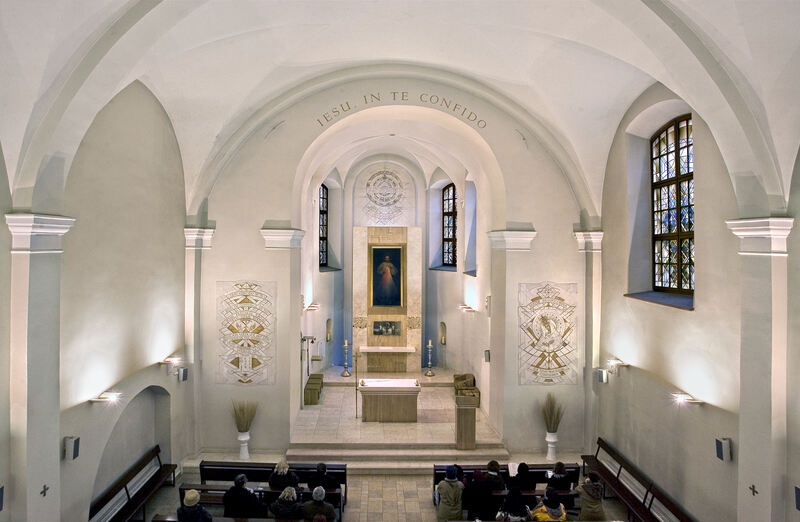
Dviejų langų vitražai Dievo Gailestingumo Šventovėje, centrinės dalies dešinėje pusėje. Bendras kompozicijos ir minties sprendimas, tai Adventinio kalėdinio laukimo laiko interpretacija. Lango rėmas platus, sudalintas į 6 dalis, kuriose sumontuoti vitražo blokai. Į vieną lango dalį sumontuoti 6 vitražo blokai. Langus apjuosia balta, pusiau matinė stiklo juosta. Antra juosta geltonos, sepijos matine glazura modeliuoti, tonuoto stiklo trikampiai mozaikiniai gabalėliai. Į centrą subėga ir iš centro kyla, kryžminasi balti matiniai spinduliai, su išbraižytais ornamentiniais ženklais. Spalvotų, mėlynų, geltonų, sepijos, pilkų, violetinių matintų stiklų detalės rombais, kvadratais koncentruojasi į centro kompoziciją, pakopomis kyla iš apačios lyg šakų susipynimai - abstrahuotas kalėdinės eglės įvaizdis. Linijinis, gra.nis, ornamentinis, susikertančių baltų matinių spindulių žaismas su įv. glazūrų detalėmis - ženklais, lyg ažūrinis šventinis Kalėdinis audinys lange. Dievo Gailestingumo šventovėje, Vilniuje (architektai V. Tracevičius, A. Šolienė, A. Samukienė).