About the Church
Construction of the church began in 1387 on the initiative of Jogaila, at the time Lithuania was being converted to Christianity. It was built at the junction of important streets, becoming the first masonry parish church in Vilnius. Its Gothic architecture reflects medieval building traditions, though over the centuries it underwent numerous transformations.
Over its long history Sts John's Church burned down and was rebuilt several times. One of the most significant periods was the 18th century, when, after major fires, the church was rebuilt in the Baroque style to a design by the noted architect Johann Christoph Glaubitz. This gave the building the ornateness and elegance it has today. The bell tower, built in 1600–1610, is the tallest structure in Vilnius Old Town — its height reaches as much as 69 metres — and it houses a Foucault pendulum, a scientific instrument used to demonstrate the fact of the Earth's rotation on its axis.
The church has an abundance of works of art and items of historical value. Here stands the organ with a bust of the famous composer Stanisław Moniuszko, who himself played the organ here in the 19th century. We can also find memorial monuments to such notable figures as Adam Mickiewicz, Władysław Syrokomla and Tadeusz Kościuszko.
During the Soviet era the church went through hard times — it was closed and its treasures scattered. For a long time a paper warehouse operated here, until in 1963 the building was handed over to Vilnius University and later restored. In 1989 the frescoes in the chapels were renewed, and in 1990 the church was returned to the faithful.
Sts John's Church is an important religious and cultural centre, where Mass, concerts and various events take place. It is also renowned for its great organ, which has 64 stops and is the largest in Lithuania.
A visit to Sts John's Church lets one feel the spirit not only of religion but also of Lithuania's history. Every architectural element, every fresco or altar tells its own unique story, inviting visitors to become part of this impressive narrative.
Gallery and Resources
Archive captions are shown in Lithuanian.

Medalyje pavaizduota kompozicija iš kelių Vilniaus senamiesčio statinių: kairėje matosi Vilniaus Šv. arkangelo Mykolo bažnyčia, su šventoriaus tvora ir varpine, centre – kelios senamiesčio gatvelės, dešinėje – keli dviejų aukštų pastatai, o tolumoje pavaizduota Vilniaus Šv. Jono Krikštytojo ir Šv. Jono apaštalo ir evangelisto bažnyčios varpinė ir fasadas. Medalio apačioje, ant vaizduojamos gatvės, iškilus užrašas „VILNIUS“. Panašus bažnyčios vaizdas yra Ivano Trutnevo paveiksle. Medalyje proporcijos ir objektų išdėstymas šiek tiek pakeisti. Medalis tamsiai rudas, kai kurios vaizdo detalės tamsesnės, vaizdinė pusė įgaubta, kraštai netaisyklingi. Viršuje yra 7 x 2 mm kiaurymė. Medalio reversas – tamsiai rudos spalvos keramikos paviršius su tekstilės atspaudu.
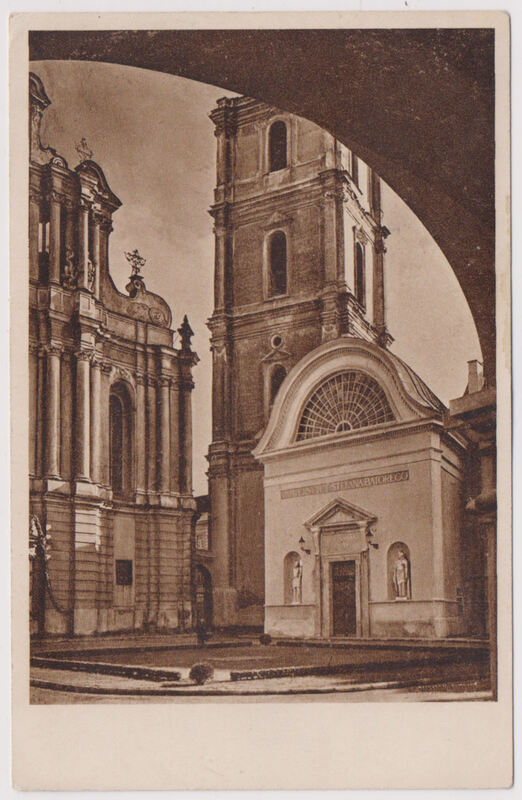
Atvirukas, nespalvotas. Pavaizduotas Vilniaus Universiteto kiemas ir Šv. Jono Krikštytojo ir Šv. Jono apaštalo ir evangelisto bažnyčia. Kitoje atviruko pusėje yra pavadinimas lietuvių kalba. Atvirukas išleistas pagal Jano Bulhako nuotrauką, spausdino „Spindulio“ spaustuvė, išleido „Spaudos Fondas“.