About the Church
The Church of the Crucified Jesus in Pernarava is remarkable for its history and architecture. Situated in the town of Pernarava, this wooden church has stood for more than two centuries, since 1815.
The first church built here dates back to the 17th century, more precisely to around 1670–1671. It is said to have been built on the site of an old pagan temple, the land for its construction donated by the local landowner Jonas Milvydas. This shows the deep religious heritage of the local community and its constant efforts to maintain a sacred space.
In 1815 the present church was built by H. Zabiela. At first it was a filial church of the Ariogala parish, but later, after many years, it became a separate parish. In the middle of the 19th century a parish school operated by the church, showing that it was part not only of a spiritual but also of a cultural and educational centre for the local community. The church has been renovated more than once; one of the larger renewals took place in 1913, when the altars were refurbished.
Architecturally, the church is charming for its vernacular architectural form. The single-towered church, of rectangular plan, with a square tower twice as high as the church's own roof, gives it a distinctive character. The large doors with a semicircular arch, and the round window with a sun-ornament above them, lend the church grace and elegance. The tower has three large openings for the bell, and its complex roof construction, with triangular gablets visible around a concave pyramid, only underscores the beauty of traditional vernacular architecture.
The churchyard is surrounded by a masonry wall covered with an old-fashioned wooden roof, and the entrance to it is through iron gates between masonry posts reminiscent of small wayside chapels. The whole setting seems to tell of the passage of time and the devotion of the local people to their faith.
The Church of the Crucified Jesus in Pernarava is not only an architectural monument but also a living witness to local history, linking the past with the present.
The first church built here dates back to the 17th century, more precisely to around 1670–1671. It is said to have been built on the site of an old pagan temple, the land for its construction donated by the local landowner Jonas Milvydas. This shows the deep religious heritage of the local community and its constant efforts to maintain a sacred space.
In 1815 the present church was built by H. Zabiela. At first it was a filial church of the Ariogala parish, but later, after many years, it became a separate parish. In the middle of the 19th century a parish school operated by the church, showing that it was part not only of a spiritual but also of a cultural and educational centre for the local community. The church has been renovated more than once; one of the larger renewals took place in 1913, when the altars were refurbished.
Architecturally, the church is charming for its vernacular architectural form. The single-towered church, of rectangular plan, with a square tower twice as high as the church's own roof, gives it a distinctive character. The large doors with a semicircular arch, and the round window with a sun-ornament above them, lend the church grace and elegance. The tower has three large openings for the bell, and its complex roof construction, with triangular gablets visible around a concave pyramid, only underscores the beauty of traditional vernacular architecture.
The churchyard is surrounded by a masonry wall covered with an old-fashioned wooden roof, and the entrance to it is through iron gates between masonry posts reminiscent of small wayside chapels. The whole setting seems to tell of the passage of time and the devotion of the local people to their faith.
The Church of the Crucified Jesus in Pernarava is not only an architectural monument but also a living witness to local history, linking the past with the present.
Gallery and Resources
Archive captions are shown in Lithuanian.
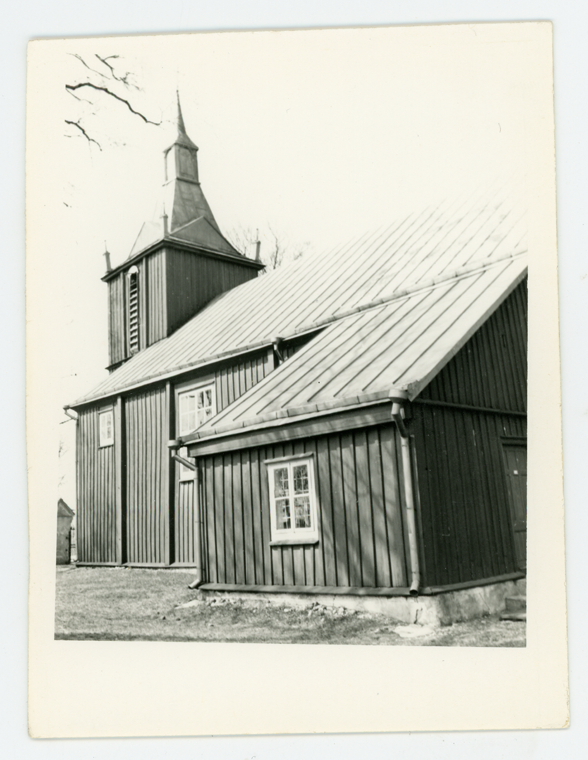
Pernaravos Nukryžiuotojo Jėzaus bažnyčia.
Pirmoji Pernaravos bažnyčia pastatyta 1670-1671 m., manoma, pagoniškos šventyklos vietoje. Dabartinė medinė bažnyčia pastatyta 1815 m. Bažnyčia remontuota 1913 m., atnaujinti altoriai.