About the Church
The Church of the Holy Trinity in Šėta is one of the most remarkable architectural gems of Kėdainiai district, situated in the small town of Šėta, near the road leading from Kėdainiai to Ukmergė. This sacred building has a long and rich history worth hearing.
The church's history begins in the 15th century: in 1499 the owner of Šėta, Bagdonas Petkevičius, together with Steponas Kuncevičius, built the first church and endowed it with a benefice. However, at the end of the 16th century the church was handed over to the Evangelical Reformed community. The local Catholics did not give up, though, and in 1680 the Vilnius canon Motiejus Ancuta rebuilt a new wooden church.
The masonry church built between 1772 and 1782 became a truly impressive structure, but it burned down on 17 May 1805 during a fire in the town. Twelve years later, in 1817, the church was rebuilt. At the end of the 19th century a project to enlarge the church was drawn up, during which a tower was built and other improvements made.
The church suffered repeated historical upheavals – it was damaged during the First World War. But parish priest Jurgis Tilvytis and his successors were not indifferent: they repaired it and restored it to life. In 1918, through the efforts of parish priest F. Kapočius and the community, a junior secondary school of the "Saulė" society was founded.
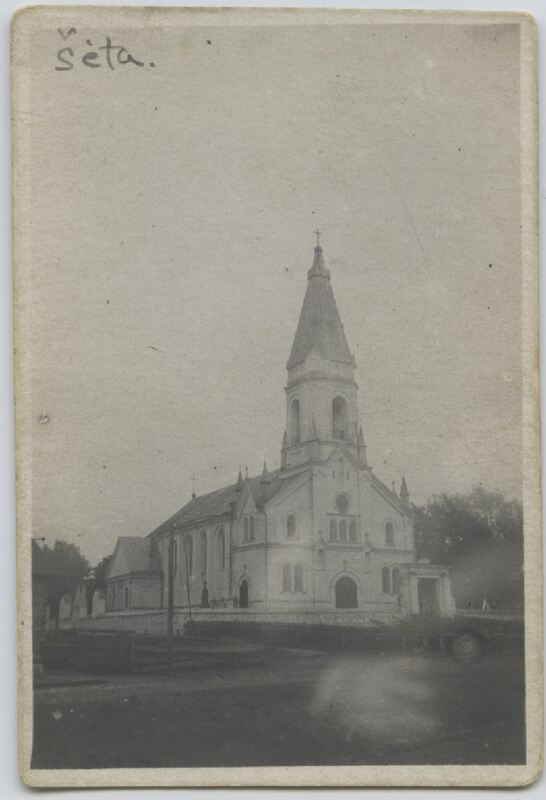
Architecturally, the Church of the Holy Trinity in Šėta stands out for its Historicist features and its rectangular plan with a massive tower. Inside, the church has three naves, and the churchyard is enclosed by a masonry wall. In the churchyard also stands a masonry chapel, known as a charnel house, containing a monument to the martyr Adelė Dirsytė and a gravestone cross for priest Antanas Danila. A wayside chapel-pillar commemorating murdered unborn children can also be found here.
The Church of the Holy Trinity in Šėta is not only an architectural monument but also a place where various historical layers and human fates intertwine. Its walls recall countless events, and every visit here allows one to feel part of its grand past.
The church's history begins in the 15th century: in 1499 the owner of Šėta, Bagdonas Petkevičius, together with Steponas Kuncevičius, built the first church and endowed it with a benefice. However, at the end of the 16th century the church was handed over to the Evangelical Reformed community. The local Catholics did not give up, though, and in 1680 the Vilnius canon Motiejus Ancuta rebuilt a new wooden church.
The masonry church built between 1772 and 1782 became a truly impressive structure, but it burned down on 17 May 1805 during a fire in the town. Twelve years later, in 1817, the church was rebuilt. At the end of the 19th century a project to enlarge the church was drawn up, during which a tower was built and other improvements made.
The church suffered repeated historical upheavals – it was damaged during the First World War. But parish priest Jurgis Tilvytis and his successors were not indifferent: they repaired it and restored it to life. In 1918, through the efforts of parish priest F. Kapočius and the community, a junior secondary school of the "Saulė" society was founded.
Architecturally, the Church of the Holy Trinity in Šėta stands out for its Historicist features and its rectangular plan with a massive tower. Inside, the church has three naves, and the churchyard is enclosed by a masonry wall. In the churchyard also stands a masonry chapel, known as a charnel house, containing a monument to the martyr Adelė Dirsytė and a gravestone cross for priest Antanas Danila. A wayside chapel-pillar commemorating murdered unborn children can also be found here.
The Church of the Holy Trinity in Šėta is not only an architectural monument but also a place where various historical layers and human fates intertwine. Its walls recall countless events, and every visit here allows one to feel part of its grand past.
Gallery and Resources