About the Church
At the start of the 17th century the Kelmė church underwent considerable upheaval. The parish priest B. Kotarskis converted to the Reformation in 1581, and from 1596 the Reformed Church began holding services here. The Catholics, however, did not give up – in 1606 a legal case began for the return of the church, and by 1608 it had already been returned to the Catholics. Unfortunately the church burned down in 1613, but was rebuilt in 1672 and later rebuilt again in 1745.
At the end of the 19th century a large part of the surrounding villages – Dikšiai, Kušleikiai, Norkiai, Sutkiai and Tolišiai – belonged to the Kelmė church. This period also saw the start of construction of the new church. In 1900 the design by the architect J. P. Dziekoński was approved, and in 1901, after the old wooden church was demolished, the foundations of the future masonry shrine were blessed. Construction was overseen by the architect Nikolai Andreyev, and through the efforts of parish priest Petras Janušauskas the church was built in 1908 and consecrated the same year.
The church's architecture is distinguished by the Gothic Revival style. It has a Latin-cross plan, with three aisles separated inside by piers. The facade is dominated by a tall tower, and a smaller turret can be seen at the crossing of the roofs. The churchyard fence is likewise not plain – its arched gates lend it additional beauty and solemnity.
Besides its architectural details, the Kelmė church also has important cultural significance. From 1910 to 1914 a branch of the Lithuanian Catholic Temperance Society operated here, promoting the moral and spiritual life of the community.
Today the Church of the Assumption of the Blessed Virgin Mary at Kelmė is not only a centre of religious attraction but also an important cultural heritage site, enriching the landscape of Kelmė with its history and enduring value.
Gallery and Resources
Archive captions are shown in Lithuanian.

Nuotrauka. Kelmės Švč. Mergelės Marijos ėmimo į dangų bažnyčia. Šioje bažnyčioje 1959–1960 m. Ričardas Mikutavičius buvo vikaras.
Bažnyčia neogotikinė, lotyniško kryžiaus plano, su trisiene apside ir aukštu fasado bokštu. Stogų kryžmoje yra bokštelis. Šventoriaus tvora mūrinė, su arkiniais vartais.
Nuotraukoje matosi raudono mūro bažnyčios sienos, fasado bokštas, skardinis stogas. Fotografuota iš tolo, matosi balta mūro tvora ant akmeninio pagrindo, aukšti medžiai šventoriuje, gatvė prieš bažnyčią. Fotografuota Z. Baltrušio. 2005 m. Kelmė.
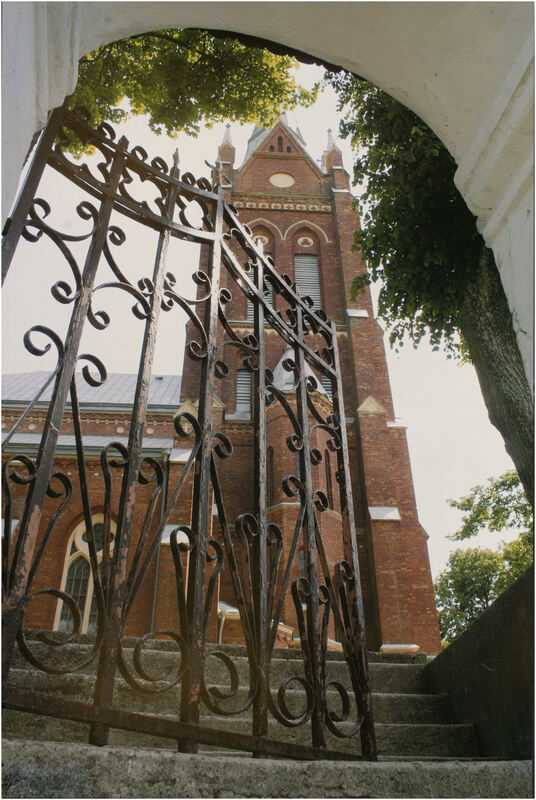
Nuotrauka. Kelmės Švč. Mergelės Marijos Ėmimo į dangų bažnyčia. Šioje bažnyčioje 1959–1960 m. Ričardas Mikutavičius buvo vikaras.
Bažnyčia neogotikinė, lotyniško kryžiaus plano, su trisiene apside ir aukštu fasado bokštu. Stogų kryžmoje yra bokštelis. Šventoriaus tvora mūrinė, su arkiniais vartais.
Nuotraukoje matosi raudono mūro bažnyčios sienos, fasado bokštas, skardinis stogas. Išryškintas metalinių, šiek tiek rūdijančių vartų fragmentas. Fotografija Z. Baltrušio. 2005 m. Kelmė.

Miesto bažnyčia. Šalia - "Blaivybės arbatinės" pastatas.