About the Church
The Church of St Anne in Dūkštai is an impressive building, rich in historical heritage, standing in the village of Dūkštai, near Maišiagala. It undoubtedly draws attention for its architecture and for its interesting and complex history.
The church's roots reach back to the 17th century, when in 1647 Darata Giedraitytė-Daubarienė, the owner of the Dūkštai manor, built a chapel. This was the beginning of what later grew into the Church of St Anne in Dūkštai. In the 18th century the Dūkštai manor farm passed to the Piarists of Raseiniai, who were active there and ran the parish school.
In 1772 a half-wooden, half-masonry church was built, its construction overseen by the rector, Father M. Franckevičius. The times were not peaceful, as shown by the fact that the Piarist priest Jonas Vičevskis was condemned by a court martial in 1831 for reading out the insurgents' manifesto.
Later, after the closure of the Piarist monastery in Vilnius in 1842, the church remained with the faithful, until in 1850–1856 the present masonry church was built to a design by Tomas Tišeckis, under the direction of the Piarist priest Joakimas Dembinskis. However, difficult times began at the end of the 19th century: in 1867 the Governor of Vilnius proposed handing the church over to the Orthodox Church, and in 1868 it was closed and turned into an Orthodox church.
Despite everything, the parishioners did not give up. The peasant Jackus Klimas travelled to St Petersburg to petition the tsar to return the church to the Catholics. Unfortunately, his efforts ended in arrest. The Catholics continued to fight for their right to have a place of worship, and eventually, after many years of effort, the church was repaired and in 1918 became a parish church.
Architecturally, the Church of St Anne in Dūkštai is Gothic Revival in style, on a rectangular plan, single-towered with turrets, and without an apse. Inside, ornate interior elements can be seen, while the side facade and the organ loft lend the church further distinctiveness and beauty.
Every church has its own history, but the Church of St Anne in Dūkštai stands out for its long and winding path through turbulent times, testifying to the people's endurance and faith, which could not be destroyed even in the most difficult of circumstances.
The church's roots reach back to the 17th century, when in 1647 Darata Giedraitytė-Daubarienė, the owner of the Dūkštai manor, built a chapel. This was the beginning of what later grew into the Church of St Anne in Dūkštai. In the 18th century the Dūkštai manor farm passed to the Piarists of Raseiniai, who were active there and ran the parish school.
In 1772 a half-wooden, half-masonry church was built, its construction overseen by the rector, Father M. Franckevičius. The times were not peaceful, as shown by the fact that the Piarist priest Jonas Vičevskis was condemned by a court martial in 1831 for reading out the insurgents' manifesto.
Later, after the closure of the Piarist monastery in Vilnius in 1842, the church remained with the faithful, until in 1850–1856 the present masonry church was built to a design by Tomas Tišeckis, under the direction of the Piarist priest Joakimas Dembinskis. However, difficult times began at the end of the 19th century: in 1867 the Governor of Vilnius proposed handing the church over to the Orthodox Church, and in 1868 it was closed and turned into an Orthodox church.
Despite everything, the parishioners did not give up. The peasant Jackus Klimas travelled to St Petersburg to petition the tsar to return the church to the Catholics. Unfortunately, his efforts ended in arrest. The Catholics continued to fight for their right to have a place of worship, and eventually, after many years of effort, the church was repaired and in 1918 became a parish church.
Architecturally, the Church of St Anne in Dūkštai is Gothic Revival in style, on a rectangular plan, single-towered with turrets, and without an apse. Inside, ornate interior elements can be seen, while the side facade and the organ loft lend the church further distinctiveness and beauty.
Every church has its own history, but the Church of St Anne in Dūkštai stands out for its long and winding path through turbulent times, testifying to the people's endurance and faith, which could not be destroyed even in the most difficult of circumstances.
Gallery and Resources
Archive captions are shown in Lithuanian.
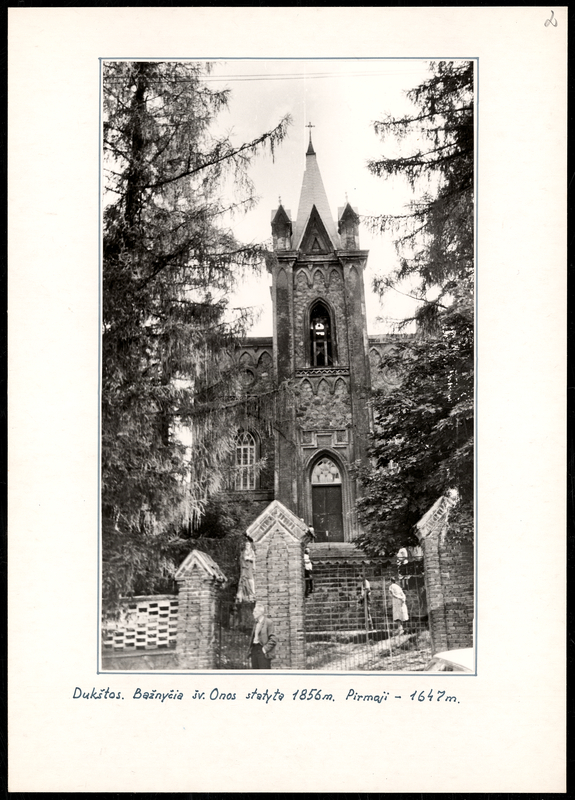
Dūkštų Šv. Onos bažnyčia. Fotografijos aprašymas ant pasporto: „Dukštos. Bažnyčia šv. Onos statyta 1856 m. Pirmoji – 1647 m.“