About the Church
The Church of the Holy Trinity in Rykantai is an outstanding historical and architectural monument, situated in the village of Rykantai, near Trakai. Built in 1585, the church has retained not only its distinctive Gothic construction but also elements of Renaissance forms, making it especially valuable both culturally and architecturally.
The church is of the hall type, meaning its interior consists of three aisles separated by piers, with a wide chancel and a three-sided apse. This makes it similar to St Nicholas' Church in Vilnius. Interestingly, the church's design resembles the Church of the Holy Trinity in Žadiškiai, Belarus, near the Neris. A sacristy is attached to the south wall of the chancel, and a cellar lies beneath the church itself. On the west façade one can see an original Renaissance gable, in whose central niche an 18th-century fresco depicting St George has survived. This fresco is distinguished by features of Lithuanian folk painting – simple, decorative and flat forms of the horse and rider.
History tells that until 1555 a wooden Reformed Evangelical church stood here. The present masonry church was built in 1585 by Adomas Tolvaiša, but as he left no heirs, in the 17th century Rykantai passed to the Catholic Oginskis family. During the war between the Polish–Lithuanian Commonwealth and Russia in 1655, Moscow's troops ravaged the church, but it was rebuilt by Marcijonas Aleksandras Oginskis by 1688. The church is rich in works of art: on either side of the high altar are epitaph portraits of Marcijonas Oginskis and his wife, painted by Jonas Jonavičius, compositions on the theme of the Passion of Christ, and images of saints of the Dominican Order in the niches of the organ-loft wall.
In 1696 the church was empty and abandoned, and services were held at the Rykantai manor. In 1688 Marcijonas Oginskis had donated the church, together with the Rykantai manor, to the Dominicans of Trakai. However, for mysterious reasons the Dominicans could not hold services in the former Calvinist church, as the priests who celebrated Mass there died soon after. Therefore in 1725 another, wooden church was built, which by 1784 had already rotted.
During the Napoleonic War in 1812 the church suffered again – liturgical items were stolen. By the mid 19th century the church had fallen into disrepair again, but in 1888–1889 it was renovated: the plaster was repaired and whitewashed, and the roof was re-covered. A parish was established in 1921, and the church belonged to the Paneriškės farmstead, with almost 50 hectares of land. In 1935 the church was restored again, and for the last time in 1975.
The Church of the Holy Trinity in Rykantai, with its three-sided apse and attached sacristy, is an important example of Lithuanian architecture, reflecting the meeting of Gothic and Renaissance. Its treasury of frescoes, surviving since 1668, adds still more historical and cultural value.
Despite all its historical hardships, this church still stands as a living testament to the events of the past and the people who contributed to its construction and restoration.
The church is of the hall type, meaning its interior consists of three aisles separated by piers, with a wide chancel and a three-sided apse. This makes it similar to St Nicholas' Church in Vilnius. Interestingly, the church's design resembles the Church of the Holy Trinity in Žadiškiai, Belarus, near the Neris. A sacristy is attached to the south wall of the chancel, and a cellar lies beneath the church itself. On the west façade one can see an original Renaissance gable, in whose central niche an 18th-century fresco depicting St George has survived. This fresco is distinguished by features of Lithuanian folk painting – simple, decorative and flat forms of the horse and rider.
History tells that until 1555 a wooden Reformed Evangelical church stood here. The present masonry church was built in 1585 by Adomas Tolvaiša, but as he left no heirs, in the 17th century Rykantai passed to the Catholic Oginskis family. During the war between the Polish–Lithuanian Commonwealth and Russia in 1655, Moscow's troops ravaged the church, but it was rebuilt by Marcijonas Aleksandras Oginskis by 1688. The church is rich in works of art: on either side of the high altar are epitaph portraits of Marcijonas Oginskis and his wife, painted by Jonas Jonavičius, compositions on the theme of the Passion of Christ, and images of saints of the Dominican Order in the niches of the organ-loft wall.
In 1696 the church was empty and abandoned, and services were held at the Rykantai manor. In 1688 Marcijonas Oginskis had donated the church, together with the Rykantai manor, to the Dominicans of Trakai. However, for mysterious reasons the Dominicans could not hold services in the former Calvinist church, as the priests who celebrated Mass there died soon after. Therefore in 1725 another, wooden church was built, which by 1784 had already rotted.
During the Napoleonic War in 1812 the church suffered again – liturgical items were stolen. By the mid 19th century the church had fallen into disrepair again, but in 1888–1889 it was renovated: the plaster was repaired and whitewashed, and the roof was re-covered. A parish was established in 1921, and the church belonged to the Paneriškės farmstead, with almost 50 hectares of land. In 1935 the church was restored again, and for the last time in 1975.
The Church of the Holy Trinity in Rykantai, with its three-sided apse and attached sacristy, is an important example of Lithuanian architecture, reflecting the meeting of Gothic and Renaissance. Its treasury of frescoes, surviving since 1668, adds still more historical and cultural value.
Despite all its historical hardships, this church still stands as a living testament to the events of the past and the people who contributed to its construction and restoration.
Gallery and Resources
Archive captions are shown in Lithuanian.
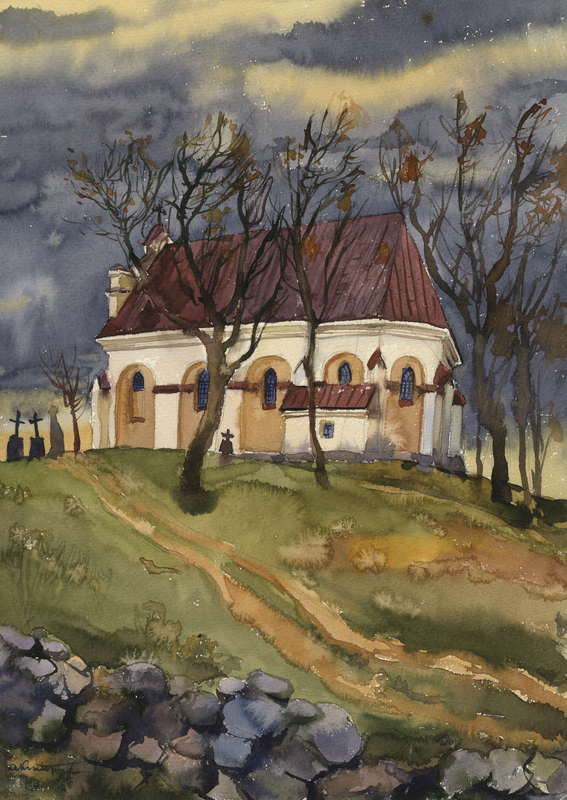
Kompozicijoje – Rykantų Švč. Trejybės bažnyčia.
Signuotas akvarele averso apatinėje dalyje kairėje: autoriaus parašu ir data: „78“, reverse pieštuku: „RYKANTAI / 1978. X. 27“.