About the Church
It all began in 1642, when Jurgis Liutauras Chreptavičius, castellan of Smolensk, generously donated 4,000 gold florins to the Vilnius Dominicans and urged them to build a church at the Lukiškės cemetery. The first church was wooden, but it soon became too small for the growing community of the faithful.
In 1684 a new wooden church rose on the same foundations; its greatest treasure was a painting of the Blessed Virgin Mary, brought from Russia in 1649. Bishop Konstantinas Kazimieras Bžostovskis declared the painting miraculous, and the church began to attract great numbers of pilgrims.
In 1784 it was decided to build a masonry church, which was finally completed in 1722. Although it was low and had only two small towers, the church was continually improved and embellished over time. The architect Abraomas Antuanas Zenas contributed important alterations, among them raising the towers in 1727–1746.
The 18th century was full of change and challenge. The church often suffered from fires, but each time it was rebuilt with even greater care and devotion. Unfortunately, in 1794 the Russian army damaged the church, though it was soon repaired again. In the 19th century a St James's hospital was established in the church, and during the Napoleonic Wars a military hospital was housed there.
During the Soviet era the church was closed and used as a fruit and vegetable warehouse, and later as a props store for the Opera and Ballet Theatre. Only after the restoration of independence, in 1992, was it returned to the faithful and revived as an oasis of spiritual peace. The high altar was restored by Česlovas Bareika and A. Žemaitis, and the sculptures by Kęstutis Norkūnas.
The architecture is no less impressive. The church has a rectangular plan and two towers, reaching a height of 24 metres, which makes it the tallest single-nave church in Lithuania. Inside there are seven altars, and the churchyard is enclosed by a plastered masonry wall. The design beautifully reflects late Baroque style, dominated by ornament and detail.
In 2015 the Vilnius carillon was installed in the church tower, adding still more resonance and beauty to both the church and the whole city. It is a place where history, art and faith come together, offering a unique and unforgettable experience to every visitor.
Gallery and Resources
Archive captions are shown in Lithuanian.
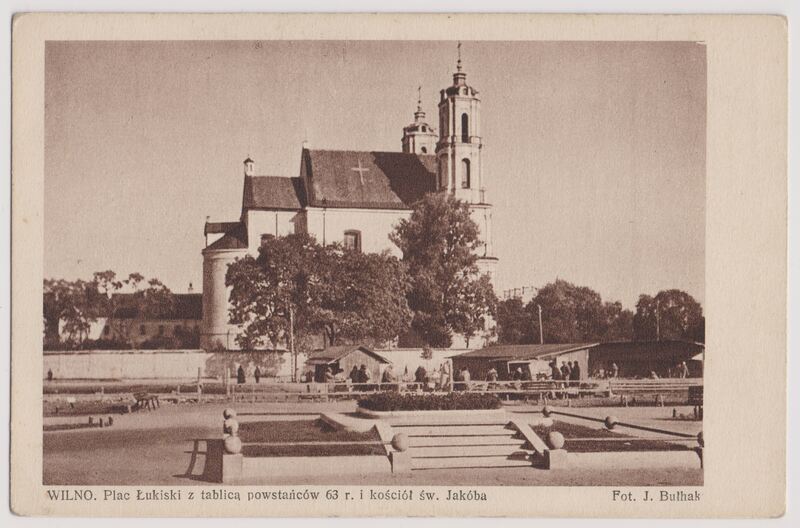
Atvirukas. Vilnius. „WILNO. Plac Lukiski z tablicą powstancow 63 r. i kosciol sw. Jakoba / Fot. J. Bulhaka“. Išleido Lenkijos Geležinkeliečių Sąjungos „Ruch“ knygynas Varšuvoje. Vaizdas rudos spalvos. Atviruke Vilniaus Šv. apaštalų Pilypo ir Jokūbo bažnyčia.
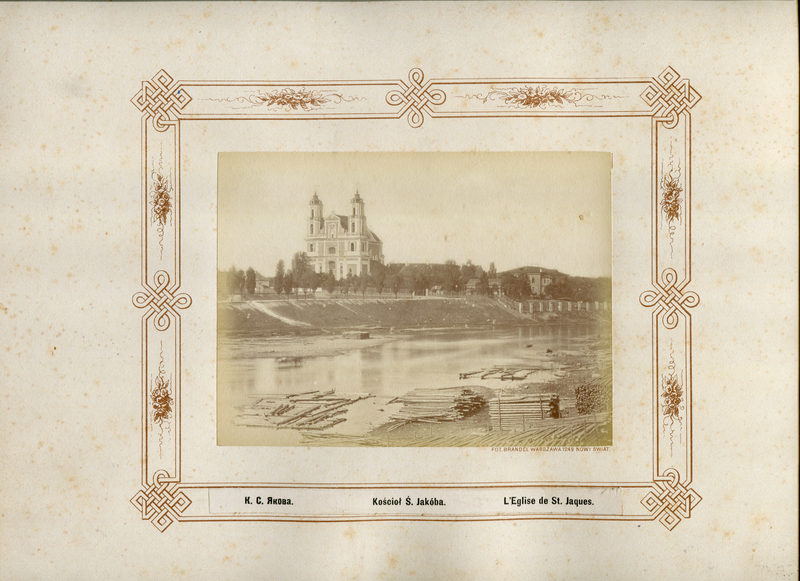
Nespalvota, horizontalaus formato fotografija. Vilniaus miesto vaizdai: Vilniaus Šv. apaštalų Pilypo ir Jokūbo bažnyčia. Fotografas Konradas Brandelis (Konrad Brandel (1838-1920)), Varšuva.
Nuotrauka priklijuota prie kartono, aprėminta geometrinio ir augalinio motyvo ornamentu. Apačioje atspaustas fotografo užrašas: " FOT.BRANDEL WARSZAWA 1249 SWIAT" (Fotografas Brandelis, Varšuva, Nowy Swiat g., 1249). Kartono apačioje priklijuota popieriaus juostelė su užrašu. Užrašas pateiktas trimis kalbomis- rusų, lenkų,prancūzų:" К С Якова / Kosciol S.Jakoba / L' Eglise de St. Jaques"