About the Church
The Church of St Joseph in Kėdainiai, situated on the quiet bank of the Nevėžis river, is one of the town's most important historical sites. This wooden church was built in 1766 and is remarkable for its architecture and rich history.
The church's history begins as early as the start of the 18th century, when the Kaunas Jesuits arrived in Kėdainiai. Around 1747 they built the first mission house and church, but it did not survive long – it fell into ruin after 1773. At the same time, the town of Kėdainiai was already being actively developed, and so in 1704 a plot was assigned to the Carmelites for a new church and monastery. This complex was completed by 1709 and became an important part of the local community.
In 1713 a parish was established in Kėdainiai, which by 1820 covered the whole town and its suburb of Janušava. However, in 1832 the Russian authorities closed the monastery, and the parish was attached to nearby Josvainiai. The monastery building was later converted into barracks.
The church's fate was not easy in the 20th century either. During the First World War it became a filial church of the St George parish in Kėdainiai and served as a place of worship for chaplain's pupils. Under Soviet rule, from 1963 to 1991, the church was closed – a warehouse of the Electrical Apparatus Factory was set up within its walls. Only in the years of independence, to a design by architect Dainius Juozėnas, was the church restored and returned to its original purpose.
Architecturally, the Church of St Joseph in Kėdainiai has a cruciform plan, a two-towered structure with a three-sided apse and a smaller turret above it. Inside there are three naves, and the churchyard is enclosed by an openwork masonry fence. Lower sacristies stand next to the chancel, and a wooden bell tower can be found in the churchyard.
The Church of St Joseph in Kėdainiai is undoubtedly part of the town's cultural and religious heritage, bearing witness to the complex history of Kėdainiai and its survival through various historical periods. Its restoration and preservation are a great achievement, allowing today's visitors to feel the spirit of the past and the beauty of its architecture.
The church's history begins as early as the start of the 18th century, when the Kaunas Jesuits arrived in Kėdainiai. Around 1747 they built the first mission house and church, but it did not survive long – it fell into ruin after 1773. At the same time, the town of Kėdainiai was already being actively developed, and so in 1704 a plot was assigned to the Carmelites for a new church and monastery. This complex was completed by 1709 and became an important part of the local community.
In 1713 a parish was established in Kėdainiai, which by 1820 covered the whole town and its suburb of Janušava. However, in 1832 the Russian authorities closed the monastery, and the parish was attached to nearby Josvainiai. The monastery building was later converted into barracks.
The church's fate was not easy in the 20th century either. During the First World War it became a filial church of the St George parish in Kėdainiai and served as a place of worship for chaplain's pupils. Under Soviet rule, from 1963 to 1991, the church was closed – a warehouse of the Electrical Apparatus Factory was set up within its walls. Only in the years of independence, to a design by architect Dainius Juozėnas, was the church restored and returned to its original purpose.
Architecturally, the Church of St Joseph in Kėdainiai has a cruciform plan, a two-towered structure with a three-sided apse and a smaller turret above it. Inside there are three naves, and the churchyard is enclosed by an openwork masonry fence. Lower sacristies stand next to the chancel, and a wooden bell tower can be found in the churchyard.
The Church of St Joseph in Kėdainiai is undoubtedly part of the town's cultural and religious heritage, bearing witness to the complex history of Kėdainiai and its survival through various historical periods. Its restoration and preservation are a great achievement, allowing today's visitors to feel the spirit of the past and the beauty of its architecture.
Gallery and Resources
Archive captions are shown in Lithuanian.
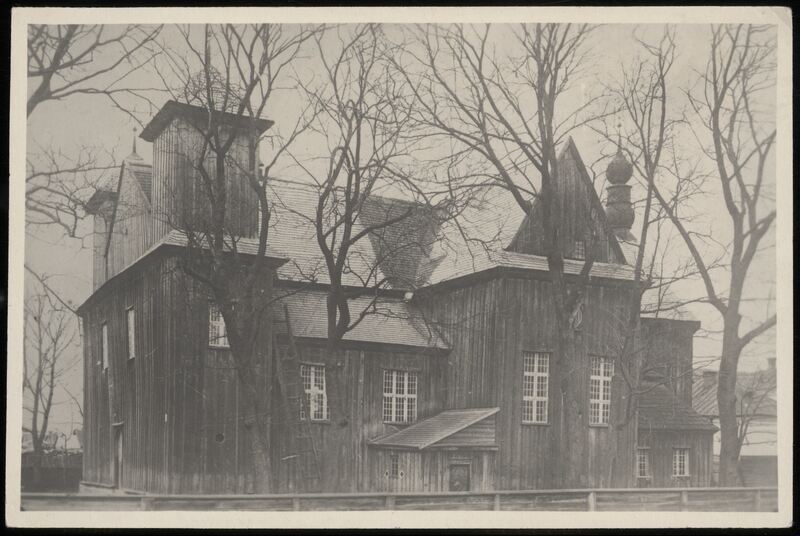
Bažnyčia, medinė, dvibokštė, dengta skiedrų stogu, užfiksuota trijų ketvirčių rakursu. Bažnyčia nufotografuota artimu planu kartu su šventoriaus medžiais ir viršutine tvoros dalimi.
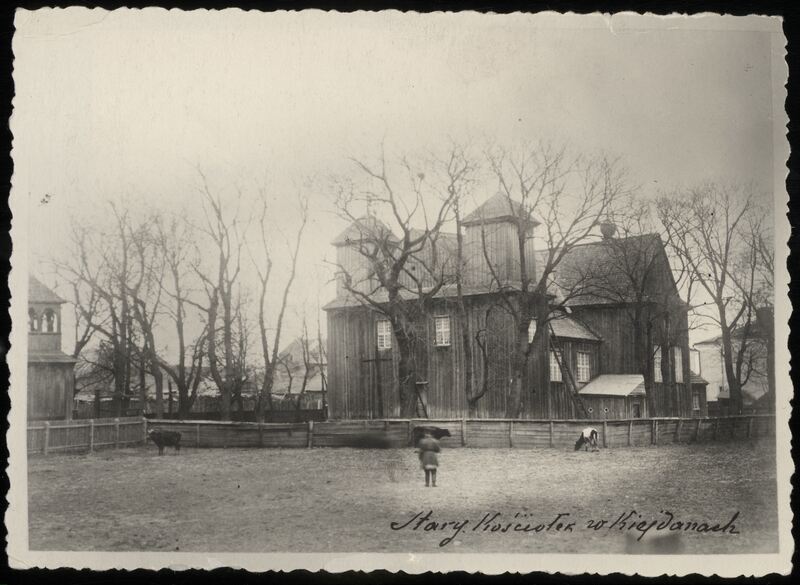
Bažnyčia, medinė, dvibokštė, dengta skiedrų stogu, užfiksuota trijų ketvirčių rakursu. Bažnyčia užfiksuota kartu su ją supančia aplinka: šventoriaus medžiais, tvora ir varpinės dalimi. Fotografinio vaizdo apačioje užrašyta ranka: „Stary Kosciolek w Kiejdanach“.