About the Church
Construction of the church began in 1694 and continued until 1717, under the architect Stanislovas Narockis. This was a period when the nobles of Lithuania sought to build religious buildings that were not only functional but also aesthetically impressive. The Voivode of Vilnius, Kazimieras Jonas Sapiega, as founder of the church, settled Trinitarian monks here, who took care of its construction and decoration.
One of the most important people who contributed to the beauty of the church was the Italian master Pietro Perti, who, using stucco mouldings, gave the interior its special splendour. The decoration of the church took a long time — from the completion of the initial works in 1716 to its final completion in 1756. Bishop Paweł Ksawery Brzostowski consecrated the church several times, assigning it various titles, such as the Holy Trinity and the Nativity of the Blessed Virgin Mary.
Unfortunately, the Church of the Saviour in Vilnius suffered more than once from historical alterations. After the 1863 uprising the tsarist authorities closed the Trinitarian monastery and converted the church into the Orthodox Church of St Michael the Archangel. During this period it was ravaged — the second-floor vaults were demolished, the rococo pulpit was destroyed, and the central altar was replaced by a porch of utilitarian form.
In the 20th century the church underwent even more changes. Between the wars it housed a military hospital and university clinics, and during the Soviet era a military quartermaster's warehouse. Only after the restoration of independence, in 1993, was the ensemble restored, and in 2000 the brothers and sisters of the Congregation of St John began to serve this place.
Architecturally the church stands out for its centralised octagonal plan, covered by an original octagonal dome. The dome's decoration and sculptures completely conceal the drum's construction, giving the church a striking visual effect. The facade features a prominent frieze of plant motifs with a group of captive soldiers, symbolising the Trinitarian mission of ransoming captives.
Inside the church, six Baroque altars and a rococo-form pulpit were erected in 1726, their decorative elements meticulously worked. On the central altar stood a copy of the miraculous statue of Jesus the Nazarene, now moved to Sts Peter and Paul's Church. In the 18th century the church's facade was completed by two massive square towers, capped with tapering spires.
Today the Church of the Saviour in Vilnius is not only a significant architectural monument but also a living witness to history, telling of the cultural and religious heritage of the city of Vilnius.
Gallery and Resources
Archive captions are shown in Lithuanian.
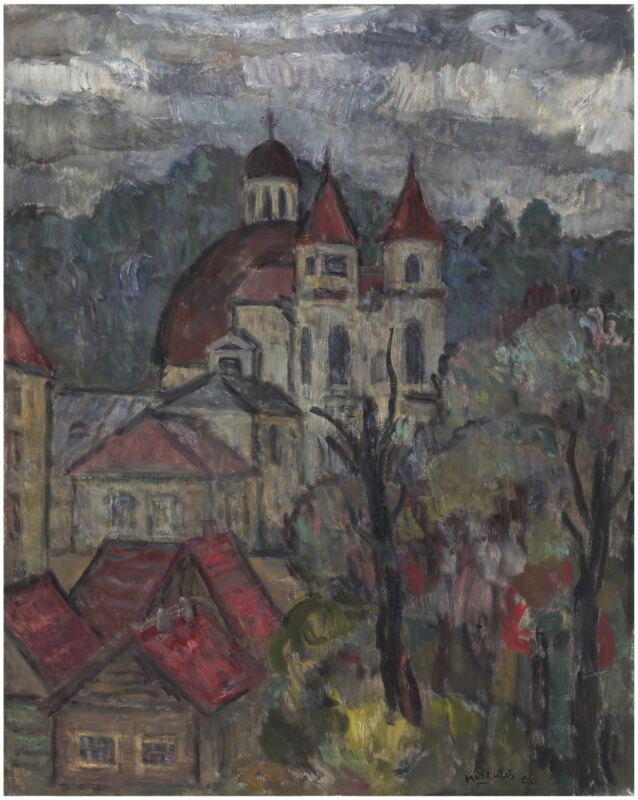
Peizaže pavaizduotas seniausias Vilniaus rajonas – Antakalnis. Priekyje perspektyvos, dešinėje pusėje, – medžiai, kairėje – namai su raudonais stogais. Toliau perspektyvos – Vilniaus išganytojo bažnyčia, dar kitaip žinoma kaip Vilniaus Viešpaties Jėzaus bažnyčia su buvusiu trinitorių vienuolynu. Bažnyčia matosi ne visa, tik jos viršutiniai kupolai ir fasadas su dviem bokštais. Architektūros fone žaliuoja miškai. Dangus pilkas, debesuotas ir niūrus. Paveiksle išryškintas juodas kontūras, kuris suteikia paveikslui dekoratyvumo. Tapyba ekspresyvių, smulkių potėpių. Koloritas tamsių, „prigesintų“ spalvų.
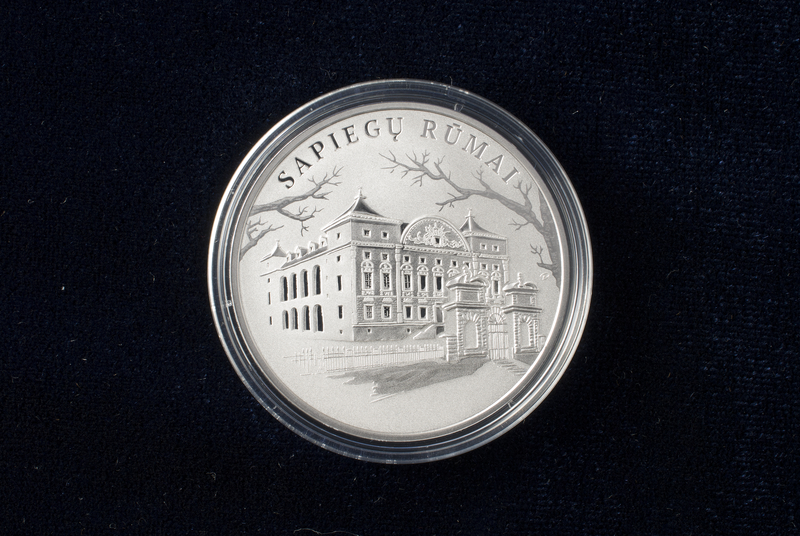
Grafinio projekto autorė Eglė Ratkutė. Tiražas – 2500 vnt. Kokybė „PROOF“. Sidabro praba – 925 (Ag). Averse pavaizduota Sapiegų rūmų kompleksui priklausanti Vilniaus Išganytojo bažnyčia, kurios fone – išskirtinis aštuonkampis bažnyčios kupolas, į kurį žvelgiama iš apačios, tarsi būnant bažnyčioje. Dešinėje monetos pusėje įkomponuotas didysis Sapiegų herbas su Vyčiu. Ties viršutiniąja averso kraštine užrašas „LIETUVA”, ties apatiniąja – nominalas „20 €”, data „2019” ir gamintojo logotipas. Reverso centre pavaizduoti Lietuvos Didžiosios Kunigaikštystės didžiojo etmono Kazimiero Jono Sapiegos, baroko laikotarpio didikų užmiesčio rūmų ir parko ansamblis. Ties viršutiniąja kraštine užrašas „SAPIEGŲ RŪMAI”. Gurtas lygus, su užrašu „LIETUVOS RŪMAI IR DVARAI * “. Moneta įtvirtinta apsauginėje kapsulėje, reprezentacinėje dėžutėje, su autentiškumo sertifikatu Nr. 0014.